India-Oman free trade pact kicks in, opens duty-free access for 99% exports
India-Oman Free Trade Pact Kicks In, Opens Duty-Free Access for 99% Exports Theindiapostdaily.com – New Delhi: The Comprehensive Economic Partnership Agreement (CEPA) between India and Oman has officially taken effect,…
India-Oman Free Trade Pact Kicks In, Opens Duty-Free Access for 99% Exports
Theindiapostdaily.com – New Delhi: The Comprehensive Economic Partnership Agreement (CEPA) between India and Oman has officially taken effect, offering Indian exports duty-free access to the Gulf nation and marking a significant advancement in their economic relationship. This milestone was achieved after both countries finalized their domestic processes, allowing the agreement to activate on Monday. The pact, inked in Muscat on 18 December 2025, is expected to boost trade and investment flows between the two nations.
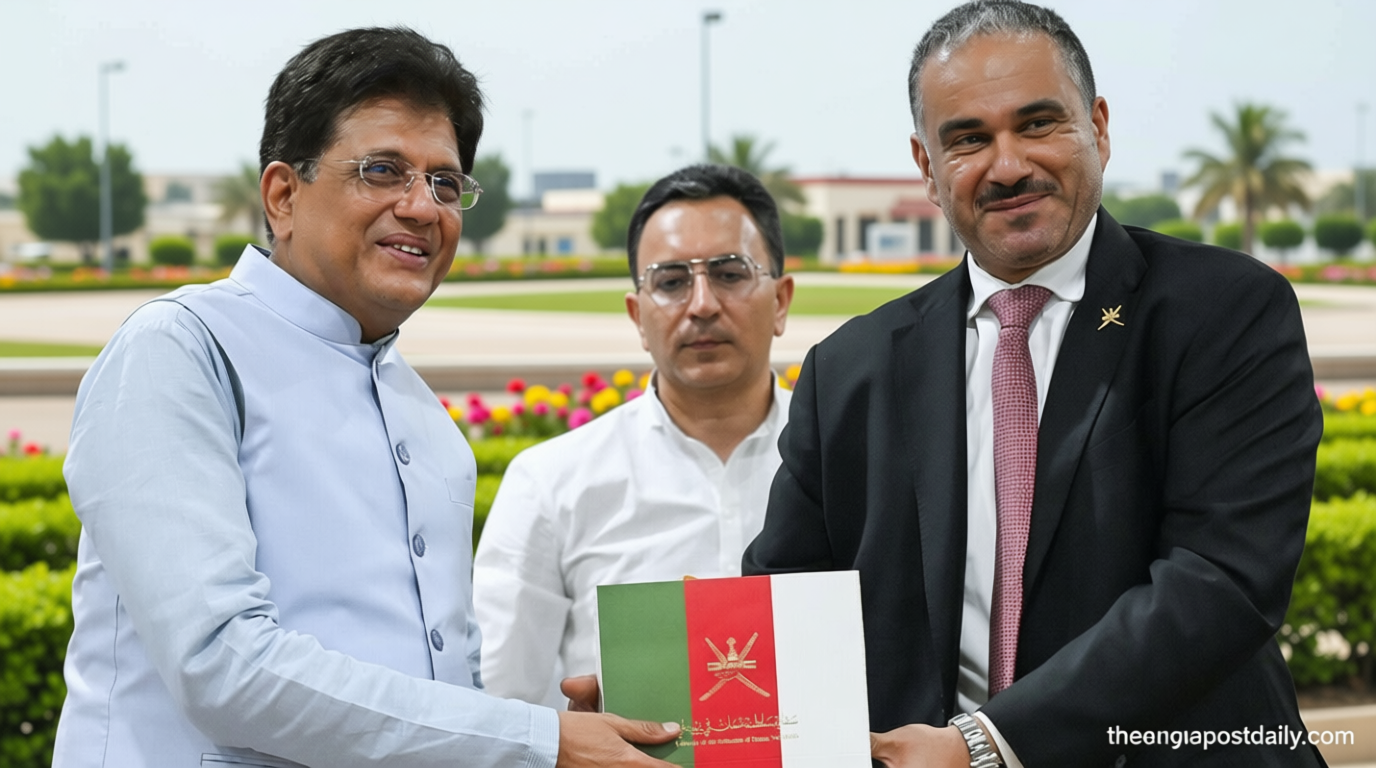
The CEPA is set to benefit a vast majority of Indian exports, with 99.38% of them now eligible for zero tariffs on Oman’s tariff lines. The commerce ministry noted that this represents a substantial improvement over previous arrangements, where only 15.33% of Indian goods entered Oman duty-free under the Most Favoured Nation (MFN) regime. The agreement’s implementation was celebrated by key officials, including India’s commerce and industry minister, Piyush Goyal, and Oman’s ambassador to India, Issa Saleh Al Shibani, who participated in the symbolic launch of the first shipments.
Key Sectors and Benefits
The CEPA is designed to enhance market access for a wide range of Indian products, including agriculture, gems, and jewellery. These items are now being shipped from major Indian cities such as Mumbai, Kolkata, and Chennai, leveraging the preferential tariff terms. Officials emphasized that the pact not only reduces trade barriers but also fosters deeper economic integration, creating new opportunities for services, logistics, and manufacturing.
“The operationalization of the India-Oman CEPA signifies a strategic shift from transactional trade to more profound economic collaboration. By securing zero-duty access on nearly all tariff lines, the agreement expands market access, promotes services sector mobility, and opens avenues for logistics, manufacturing, and investment linkages,” said Ram Singh, professor and head of the Indian Institute of Foreign Trade (IIFT) in New Delhi.
Oman is increasingly being viewed as a critical hub for Indian goods to reach the Gulf Cooperation Council (GCC), Africa, and broader West Asia. Ram Singh highlighted the potential for strengthening supply chain resilience and achieving long-term complementarity in areas such as polysilicon for solar cells, fertilizers, and defense cooperation. The CEPA, he noted, allows both nations to explore uncharted markets and align their economic interests.
Bilateral Trade Growth
Bilateral trade between India and Oman has shown steady growth, rising to $11.18 billion in fiscal year 2026 from $10.61 billion in the previous fiscal year. Oman holds the position of India’s second-largest trading partner in the Gulf region and serves as a strategic gateway to the wider GCC and East African markets, thanks to its robust logistics and port infrastructure. The agreement is seen as a catalyst for further expansion in these regions.
Piyush Goyal described the CEPA as a landmark achievement, stating, “This agreement marks a defining milestone in India’s engagement with Oman and reflects Prime Minister Narendra Modi’s vision of building trade partnerships that benefit farmers, fishermen, youth, women, entrepreneurs, and small and medium enterprises (MSMEs).” He added that the pact would unlock new opportunities for Indian exporters and professionals, reinforcing Oman as a trusted partner and a bridge to regional and global markets.
Goyal also highlighted the pact’s potential to support job creation and integrate India into regional and global value chains. He specifically mentioned labor-intensive sectors such as engineering, which has emerged as a key export to Oman. In the fiscal year 2025-26, India’s engineering exports to Oman grew by 9.1%, reaching $886 million. Products like industrial machinery, electrical equipment, auto parts, metals, and non-ferrous metals are among those set to gain from the Free Trade Agreement (FTA).
Services Sector Expansion
The CEPA extends beyond goods to include services, with Oman committing to open its markets across 127 sub-sectors. These include computer and related services, professional services, healthcare, education, financial services, telecommunications, construction, and tourism. The ministry described this as the most comprehensive services offering from any Gulf Cooperation Council (GCC) country to India, underscoring its strategic depth.
The agreement also includes binding commitments for professionals in fields such as accounting, engineering, medicine, information technology, education, and construction. This facilitates greater mobility for Indian workers in these sectors. Business visitors will now be permitted to stay in Oman for up to 90 days, while independent professionals can remain for up to 180 days. Intra-corporate transferees, meanwhile, can stay for as long as four years, enhancing cross-border employment opportunities.
Global Trade Context
Commerce secretary Rajesh Agrawal noted that the CEPA aligns with the shifting global trade dynamics, driven by supply-chain diversification and the emergence of new economic corridors. He stated, “This agreement injects new energy into our bilateral economic engagement, built on complementary strengths, deeper regulatory cooperation, and a shared commitment to growth.” The pact is positioned as a response to evolving trade patterns and a step toward more resilient economic partnerships.
The CEPA is anticipated to create a ripple effect across multiple industries. Sectors like agriculture and processed foods, marine products, pharmaceuticals, electronics, textiles, footwear, and automobiles are expected to see notable gains. Additionally, the agreement strengthens India’s foothold in the Middle East and Africa, providing a foundation for future collaboration. With its strategic location and infrastructure, Oman is poised to play a pivotal role in facilitating Indian exports to the GCC and East Africa, according to industry experts.
Experts suggest that the CEPA will not only enhance trade volumes but also promote sustainable development. By reducing tariffs and easing regulations, the pact aims to empower small businesses and encourage innovation. It also supports Oman’s aspirations to become a regional trade hub, aligning with India’s goals to expand its economic footprint in the Gulf and beyond. As both nations move forward, the agreement is expected to serve as a blueprint for future partnerships in the globalized economy.