India-US Bilateral Trade Agreement: Piyush Goyal reveals what US should announce to finalize deal
Commerce and Industry Minister Piyush Goyal stated on Thursday that New Delhi will withhold final signature on the India US Bilateral Trade Agreement until
Goyal: US Tariff Edge Required Before India Finalizes Deal
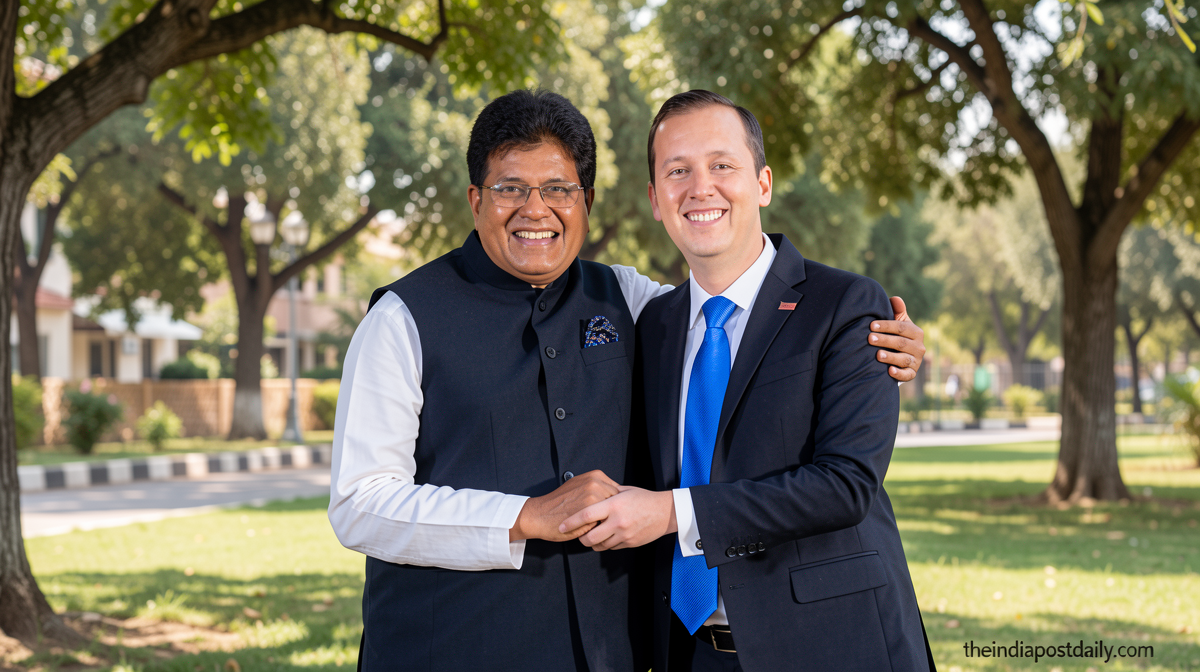
Theindiapostdaily.com – Commerce and Industry Minister Piyush Goyal stated on Thursday that New Delhi will withhold final signature on the India US Bilateral Trade Agreement until Washington extends tariff rates to Indian goods that surpass those already granted to competing exporters. Speaking at a workshop on free-trade architecture, Goyal framed the condition plainly: the deal’s last details will be announced only once American negotiators deliver a measurable preferential advantage over India’s Asian and African rivals.
“As soon as the US is able to give us the preferential rate in comparison to our competition, we will finalise the BTA and announce the final details.”
The remark crystallises a friction point that has persisted since both governments declared in February that the framework for the pact’s first phase was complete. A subsequent American policy shift — an additional 10 percent levy applied to a basket of countries, India among them, effective 24 July — has reopened the question of where Indian shipments now sit relative to duty-free or low-duty competitors. Until that question resolves in New Delhi’s favour, Goyal signalled the agreement will remain provisional.
Why the Preferential-Rate Demand Matters to Indian Industry
Textile, electronics-assembly, and intermediate-goods exporters already contend with entrenched supply-chain rivals in Sri Lanka, Bangladesh, Thailand, Cambodia, Vietnam, Indonesia, and Malaysia. If Washington were to extend those nations duty preferences that India does not receive, Indian cargo would arrive at US ports carrying a structural cost penalty. Goyal’s insistence on a comparative-advantage guarantee is therefore a viability condition for price-sensitive sectors, not a negotiating formality.
The minister also highlighted market-access channels already unlocked through India’s existing free-trade agreements and outlined a near-term roadmap: formalisation of pacts with Canada, Mexico, Chile, the Mercosur bloc, the Southern African Customs Union, the Gulf Cooperation Council, and Israel. That broadening would give domestic exporters diversified entry points beyond any single bilateral arrangement.
Exporter Pressure and the Diplomatic Calendar
Industry voices have intensified in recent weeks. On Tuesday the commerce ministry convened export-promotion-council representatives and sectoral bodies to catalogue specific grievances on US market access, review recent bilateral trade flows, and identify issues to raise with American counterparts. Delegates walked through sector-level data and pressed the ministry to accelerate finalisation, arguing that each week of tariff ambiguity erodes buyer confidence. One exporter noted that while committed US order volumes remain stable, overall throughput has contracted; American buyers, wary of shifting duty regimes, are diversifying import sources toward jurisdictions with clearer treatment.
A separate concern surfaced around US safeguard measures targeting quartz surface products. Industry members urged the ministry to raise the matter directly with Washington, viewing the safeguard as an additional uncertainty layered atop the broader tariff question.
The commercial stakes are sharpened by an imminent diplomatic window. Goyal is scheduled to travel to the United States in late September to attend the G-20 Trade Ministerial in Milwaukee, opening 30 September, and to hold bilateral discussions with US Trade Representative Jamieson Greer. A business-delegation trip to Chicago is expected the following month. The sequence gives New Delhi a concentrated opportunity to press its preferential-rate demand while American trade officials are physically present in multilateral settings.
FAQ
What exactly must the US announce before India will sign the final deal? Goyal’s stated condition is that Washington extend tariff rates to Indian goods that are more favourable than those granted to competing exporters. Once that preferential edge is confirmed, New Delhi will finalise and announce the remaining details of the India US Bilateral Trade Agreement.
When is the next scheduled diplomatic contact between the two sides? Goyal is expected in the United States in late September for the G-20 Trade Ministerial in Milwaukee (opening 30 September) and bilateral talks with USTR Jamieson Greer, followed by a business-delegation visit to Chicago the following month.
How large is the existing India–US trade relationship? Principal Indian exports to the US span electrical machinery, telecommunications instruments including smartphones, and generic pharmaceuticals, among other categories. The bilateral flow is substantial enough that even modest duty differentials can shift competitive positioning across entire sectors.