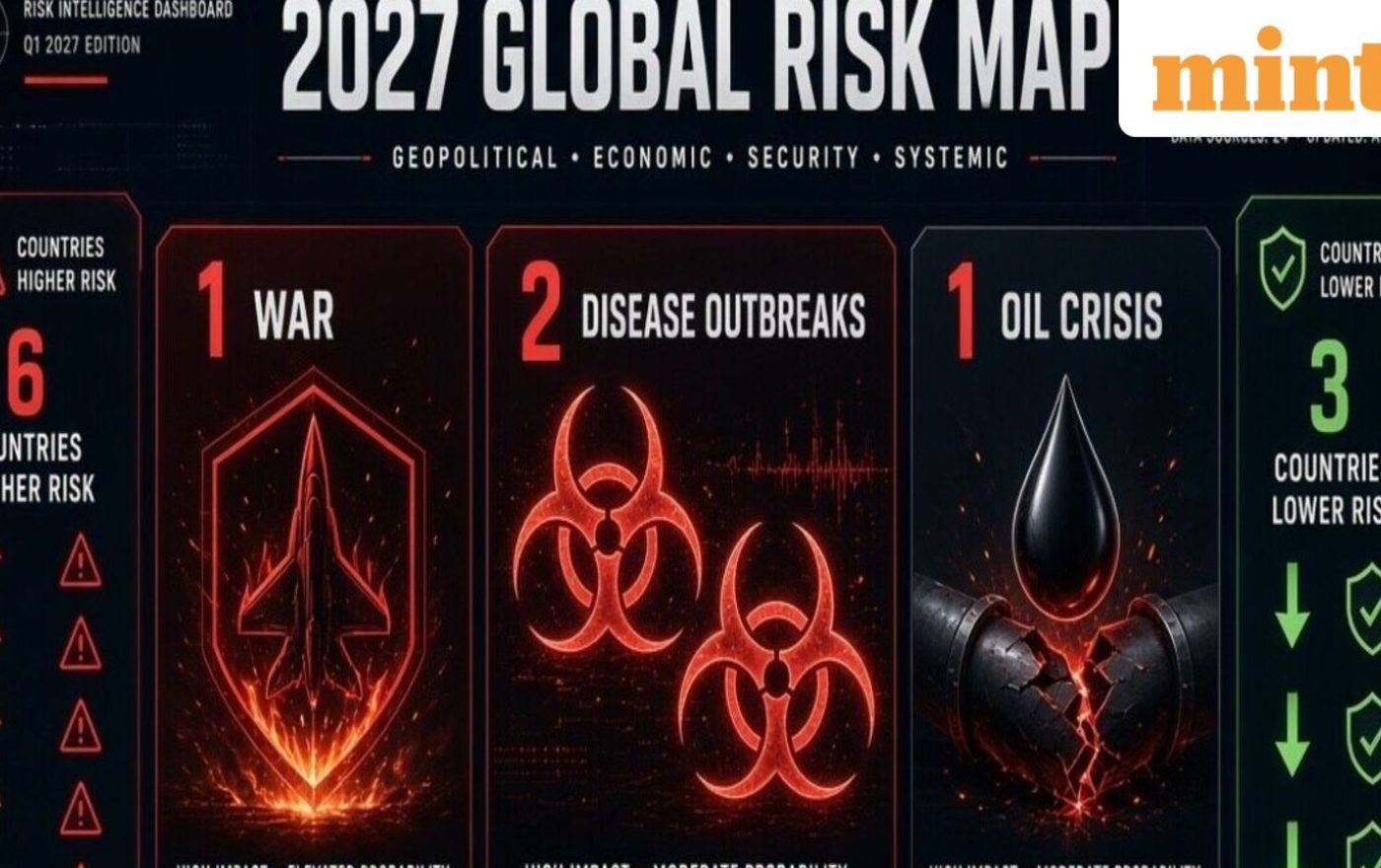
1 war, 2 disease outbreaks, 1 oil crisis, 6 countries become riskier and 3 see lower risks: Inside 2027 Global Risk Map
Security conditions are becoming more uneven across the world as conflict, public-health emergencies and pressure on energy infrastructure alter travel and
Iran Conflict and Oil Disruption Reshape the 2027 Global Risk Outlook
Theindiapostdaily.com – Security conditions are becoming more uneven across the world as conflict, public-health emergencies and pressure on energy infrastructure alter travel and operational risks for 2027. Iran has moved into the most severe category on Global Guardian’s latest Global Risk Map, while several Gulf states, Ecuador, Cuba and Saudi Arabia have also received higher risk assessments.
The map, updated in September 2026, evaluates countries through a broad range of security and resilience measures. These include violent crime, armed conflict, political stability, civil disorder, terrorism, medical capacity, infrastructure, natural hazards and the ability of essential systems to continue functioning under strain.
This edition also adopts a more detailed approach by allowing different parts of the same country to receive separate ratings. That change reflects a practical reality for businesses, travellers and residents: conditions can vary substantially between major cities, border areas, industrial zones and rural regions.
Iran reaches the extreme-risk category
Iran’s rating has risen from high risk to extreme risk as its conflict with the United States and Israel continues. The security picture is also being shaped by economic hardship and a greater possibility of arbitrary detention. Together, these factors create a more difficult environment for people moving through or operating in the country.
The wider conflict has also affected neighbouring states that host US military assets or contain strategically important commercial facilities. Bahrain and Kuwait have been shifted from moderate to high risk because of their exposure to possible Iranian attacks and the concentration of US forces in the region.
Jordan, Qatar and the United Arab Emirates have each moved from moderate to medium risk. Events during the 2026 Iran war highlighted the vulnerability of military installations and significant economic sites in those countries to Iranian strikes. The change does not mean that every location faces identical danger, but it underscores how regional conflict can extend beyond the states directly involved.
Energy infrastructure becomes a larger security concern
Saudi Arabia has also been raised from moderate to medium risk. The assessment reflects attacks affecting oil and gas facilities, air bases and Saudi Aramco sites, as well as renewed concerns tied to the conflict in Yemen.
Energy infrastructure has consequences far beyond the immediate target area. Disruption to production, shipping routes or export facilities can affect fuel availability, transport costs and supply chains across multiple regions. For organisations dependent on regular energy deliveries, contingency planning is increasingly linked to geopolitical developments in the Gulf.
One of the most consequential events influencing the 2027 outlook was the closure of the Strait of Hormuz. Global Guardian describes it as the largest disruption ever experienced by the oil market. The waterway is a critical route for oil shipments, so a closure can quickly create pressure on producers, importers and markets worldwide.
Crime, shortages and weakened services raise risks elsewhere
Ecuador has moved from medium to high risk as gang violence intensifies. Rivalries linked to cocaine trafficking, extortion and illegal mining have contributed to a worsening security climate. Criminal groups are also making greater use of explosives, including car bombs, increasing the danger posed by violence in populated areas.
The Ecuador assessment illustrates why crime trends cannot be viewed only through national averages. When organised groups are able to use explosive devices or exert control over illicit economies, the effects can reach public spaces, commercial activity and critical transport routes.
Cuba’s rating has changed from moderate to medium risk. Nationwide power cuts, fuel shortages and sanctions have placed additional stress on the electricity network and healthcare system. Interruptions to core services can magnify other risks, particularly when households, hospitals and businesses must cope with limited fuel or unstable power supplies.
For travellers and employers, such conditions make practical preparation especially important. Reliable communications, access to medical support, transportation alternatives and awareness of local service disruptions can matter as much as conventional crime precautions.
Three countries receive lower risk assessments
Not every movement on the map points toward higher danger. Jamaica’s rating has fallen from high to medium risk after a substantial decline in killings. Its homicide rate dropped by 40% from 2024 to 2025, and preliminary 2026 figures indicate that crime reductions continued.
South Korea has been reclassified from moderate to low risk. Domestic politics have become more stable following an earlier period of volatility, while structural reforms have contributed to the improved outlook. Political stability can influence risk assessments even where day-to-day physical security remains relatively strong.
Hungary has also moved from moderate to low risk. The reduction is linked to a lower likelihood of civil unrest after former Prime Minister Viktor Orbán and his Fidesz Party left power following 16 years in office.
Health emergencies remain part of the risk picture
Security planning for 2027 must account for more than armed conflict and crime. Two major health emergencies during 2026—outbreaks of hantavirus and Ebola—placed extra demands on public-health systems and affected travel policies. Disease events can quickly influence border procedures, medical capacity and the availability of personnel.
The overall picture is one of connected risks. Conflict can threaten oil routes, infrastructure attacks can disrupt vital services, shortages can place pressure on healthcare systems, and disease outbreaks can reshape mobility. The 2027 map shows that risk is no longer confined to a single category or a single border; it is increasingly shaped by how political, economic, health and security pressures interact.
Related Reading
Frequently Asked Questions
What is 1 war 2 disease outbreaks 1 oil?
1 war 2 disease outbreaks 1 oil is the main topic of this guide. The article explains the context, practical details, and next steps readers should understand.
Why does 1 war 2 disease outbreaks 1 oil matter?
1 war 2 disease outbreaks 1 oil matters because readers are looking for a useful answer, not just a short summary. Good content should match search intent and help them decide what to do next.