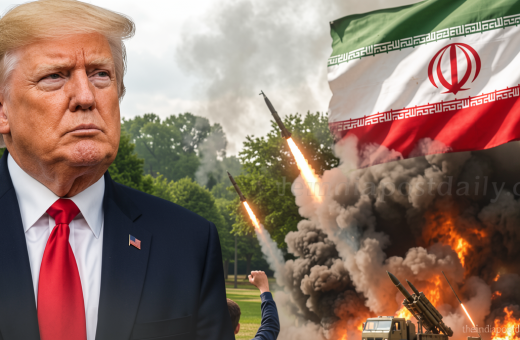
US-Iran war news LIVE: Tehran’s central bank governor says it has enough foreign currency despite US sanctions
The war between the United States and Iran has entered its sixth month with both sides digging in on two fronts: the battlefield and the balance sheet. On

Economic Pressure and Military Escalation Define the Sixth Month of US-Iran Hostilities
Theindiapostdaily.com – The war between the United States and Iran has entered its sixth month with both sides digging in on two fronts: the battlefield and the balance sheet. On Tuesday, Iran’s Central Bank Governor Abdolnaser Hemati asserted that Tehran retains adequate foreign-currency reserves to weather the ongoing American sanctions regime, a claim offered in direct rebuttal to remarks made by US Treasury Secretary Scott Bessent, who characterized Iran’s latest military posturing as a sign that the Islamic Republic is losing the economic contest.
The exchange underscores how the conflict has evolved beyond conventional kinetic operations into a sustained contest over financial endurance. Washington’s pressure campaign, as Bessent framed it, is explicitly designed to hobble Tehran’s economy by choking off access to hard currency. Hemati’s counter-claim — that the central bank’s reserves remain sufficient — is meant to signal to domestic markets and to trading partners that Iran can continue funding imports, debt service, and military procurement without capitulating to the sanctions architecture.
Diplomatic Threads and the June Framework
Amid the renewed hostilities, Iranian President Masoud Pezeshkian offered a conditional diplomatic off-ramp on Tuesday, stating that Tehran would “immediately” reciprocate if Washington returned to the interim agreement reached in June, which had been designed to halt the war. The remark left open the question of whether the United States considers that framework still viable after the latest round of strikes, but it confirmed that both capitals still regard a negotiated pause as a live option rather than a closed chapter.
Trump Vows Escalation After First Fire Exchange in Weeks
The military tempo shifted sharply on 30 August, when American forces carried out strikes on an Iranian island situated in the Strait of Hormuz. Tehran responded within hours, launching attacks aimed at US military installations across the Middle East — including targets in the United Arab Emirates and Jordan. It was the first exchange of fire between the two sides after a stretch of relative calm that had lasted several weeks.
Speaking to a Fox News reporter on Monday (local time), President Donald Trump laid out his intended course of action in blunt terms:
“We’re going to hit them hard,” Trump said. “There will be a response.”
The president simultaneously dismissed concerns that the prolonged conflict was depleting American munitions stocks, characterising the engagement as a “little war.” Treasury Secretary Bessent reinforced the economic dimension of that posture, vowing that the pressure campaign aimed at crippling Iran’s economy would continue regardless of the military tempo.
Oil Markets Price in Prolonged Hormuz Disruption
Energy traders moved quickly to embed the renewed risk into crude prices. West Texas Intermediate crude traded above $86 a barrel on Monday after posting a 2.8 per cent gain in the prior session — its largest single-day advance in three weeks. Brent crude settled near $90, extending the rally. For August as a whole, crude eked out only a marginal net increase after a month of wild swings driven by stop-start diplomatic efforts to end the war and by repeated American pledges to strangle Iran’s economy.
The Strait of Hormuz remains the critical chokepoint through which roughly a fifth of global oil consumption transits daily. Any sustained disruption — whether from deliberate strikes, mine-laying, or tanker incidents — would tighten supply balances almost immediately and push inflation expectations higher across importing economies. That transmission channel is precisely what market participants were pricing on Monday.
Gold Steadies After Two-Day Slide
Bullion, which had fallen more than 3.5 per cent over the two sessions preceding Monday, steadied around $4,445 an ounce as investors reassessed the inflation implications of renewed energy-supply risk. The logic is straightforward: if Hormuz disruptions persist, energy costs feed into headline inflation, which in turn pressures the Federal Reserve to lift interest rates. Gold, as a non-yielding asset, typically suffers under rising real yields — yet the safe-haven bid triggered by fresh hostilities partially offset that headwind, producing the observed stabilization.
Tanker Struck by Projectiles in Hormuz
The operational risk in the waterway was made concrete on Monday when the United Kingdom Maritime Trade Operations (UKMTO), the British maritime agency responsible for tracking commercial shipping in the region, confirmed that a tanker had been hit while completing an outbound transit of the strait.
“A tanker has reported being struck by 3 unknown projectiles whilst completing an outbound transit of the Strait of Hormuz,” the UKMTO posted on X.
The agency placed the incident 17 nautical miles (approximately 31 kilometres) east of Khasab, Oman. No casualties or environmental damage had been reported at the time of the bulletin. The use of “unknown projectiles” — rather than a confirmed missile or drone — left open questions about whether the strike originated from Iranian coastal batteries, a naval platform, or another actor operating in the corridor, though the timing immediately after the US-Iran flare-up made attribution straightforward for most observers.
What the Sixth Month Looks Like
Taken together, the week’s developments sketch a conflict that has settled into a pattern: periodic kinetic exchanges punctuated by economic strangulation, interspersed with diplomatic overtures that neither side has yet accepted. The Strait of Hormuz, already the most congested and strategically vital shipping lane on the planet, now carries the added burden of being a contested theatre. For global energy markets, the central variable is no longer whether hostilities resume — they have — but whether the next escalation produces a sustained closure of the waterway, a scenario that would push crude prices well beyond current levels and force central banks worldwide to recalibrate their inflation outlooks within days.
Related Reading
Frequently Asked Questions
What is US Iran war news LIVE?
US Iran war news LIVE is the main topic of this guide. The article explains the context, practical details, and next steps readers should understand.
Why does US Iran war news LIVE matter?
US Iran war news LIVE matters because readers are looking for a useful answer, not just a short summary. Good content should match search intent and help them decide what to do next.