Who is Isabel Rossi? 14-year-old Virginia student creates earthquake sensors; bags spot in top US science challenge
Who is Isabel Rossi 14 year? Isabel Rossi is a 14-year-old student from Williamsburg, Virginia, who became a finalist in the 2026 Thermo Fisher Scientific
Who Is Isabel Rossi? Virginia Teen Advances in Science Challenge
Theindiapostdaily.com – Who is Isabel Rossi 14 year? Isabel Rossi is a 14-year-old student from Williamsburg, Virginia, who became a finalist in the 2026 Thermo Fisher Scientific Junior Innovators Challenge after creating a mathematical model for improving earthquake-sensor placement.
Now a freshman at Jamestown High School, Rossi completed the research in eighth grade at James Blair Middle School. She was selected as one of 30 finalists from nearly 10,000 middle school applicants across the United States.
Using maths to improve earthquake monitoring
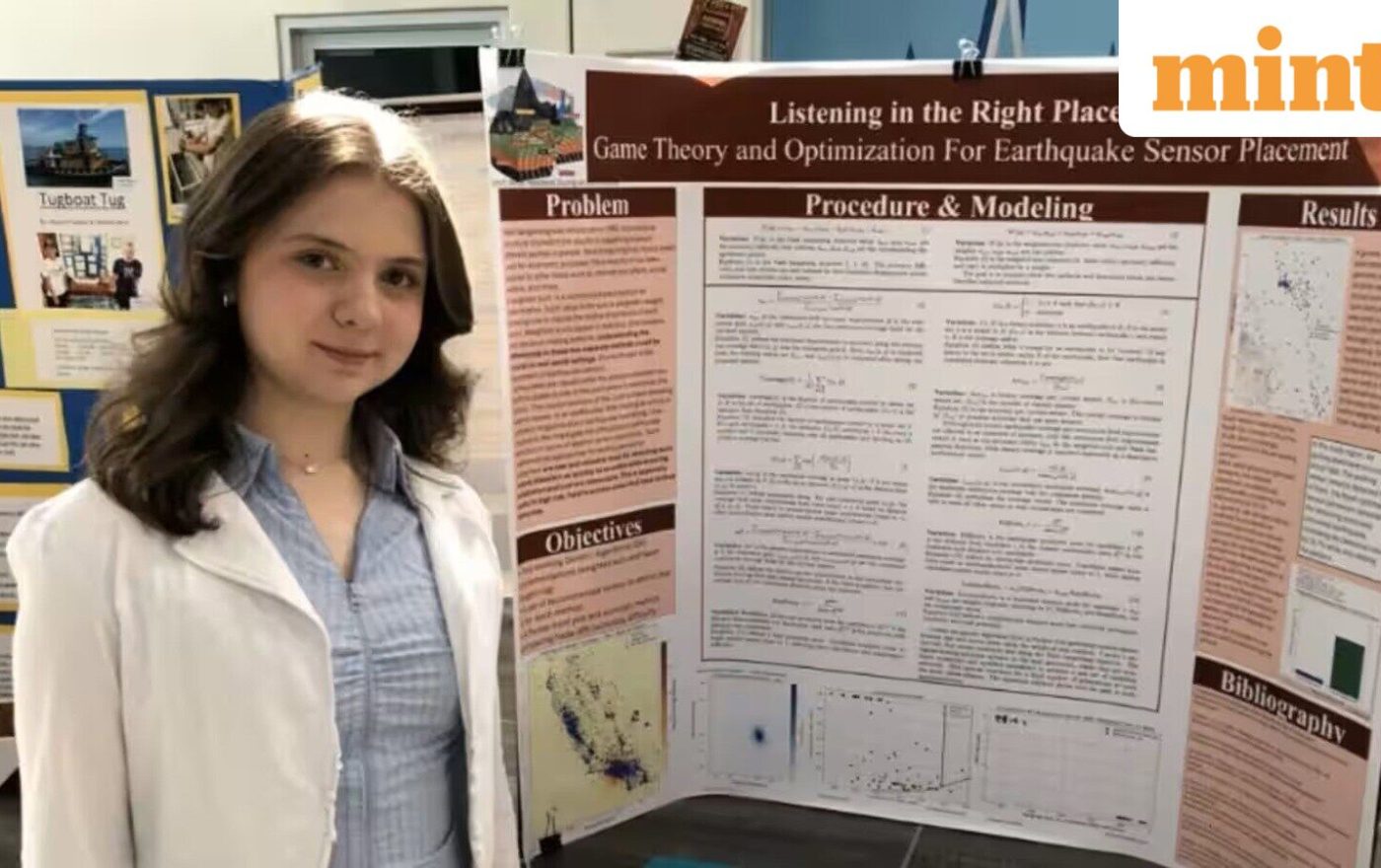
Rossi’s project, Listening in the Right Places: Game Theory and Optimisation for Earthquake Sensor Placement, examined how seismic networks could be expanded more effectively. Rather than assuming more sensors should simply be installed everywhere, her work considered where additional equipment could provide the greatest benefit.
Earthquake sensors play an important role in early-warning systems, but their placement involves difficult choices. Networks need strong coverage and reliable detection, while potential locations must also be accessible and practical for installation and maintenance.
For her six-month project, Rossi used a library of past earthquake records and existing sensor locations to simulate possible additions to the Los Angeles-area network. Her computer program generated numerous combinations of sites and compared the results.
The Who is Isabel Rossi 14 year story stands out because her research used two different mathematical methods: a weighted sum model and Nash bargaining. Nash bargaining, a game-theory concept, helps identify compromises when different goals cannot all be maximised at the same time.
She also evaluated the results against the Pareto frontier, which identifies options where improving one result would require a trade-off elsewhere. In this case, better coverage might mean choosing a location that is less convenient to access.
What Rossi’s analysis found
Rossi found that the Nash bargaining approach produced sensor layouts closer to the Pareto frontier than the weighted sum method. Her work suggests that this approach may help researchers make more balanced decisions when weighing scientific performance against real-world limitations.
Her model indicated that adding five sensors could increase earthquake-detection coverage by 16.7 per cent. The result comes from a simulation and does not guarantee the same outcome in an operating network, but it shows how modelling can help agencies assess options before investing in new equipment.
For communities facing limited budgets, challenging terrain or infrastructure constraints, virtual testing could help identify a smaller, better-planned expansion instead of a larger project with less strategic placement.
Early interest in science
Rossi’s interest in mathematics and science began early. Her father, Enrico Rossi, teaches physics at William & Mary, while her mother, Margarita Marinova, is an English professor at Christopher Newport University. She also watched her older sister experiment with chemistry and physics kits.
At age nine, Rossi began working with a retired NASA engineer. They built homemade rockets and used mathematics to improve their flight performance, an experience that strengthened her interest in applying equations to practical challenges.
I like the precision of it. Over time it’s become one of my favourite free time activities.
Beyond her research, Rossi has organised and coached a MathCounts team at her middle school and arranged a STEAM event for younger students. She plays violin with the Williamsburg Youth Orchestra and participates in environmental science activities. Her future interests include aerospace engineering, applied mathematics and medicine.
Junior Innovators Challenge final
Rossi will present her research during the Junior Innovators Challenge final round in Washington, DC, from October 23 to October 28. Finalists from 17 states and Puerto Rico will compete for more than $100,000 in awards, including a $25,000 grand prize.
The answer to who is Isabel Rossi 14 year is not limited to a competition finalist: she is a young researcher using mathematical tools to explore a real-world public-safety issue and encourage interest in science among younger students.
FAQ: Isabel Rossi and Her Earthquake Sensor Project
Where is Isabel Rossi from?
Isabel Rossi is from Williamsburg, Virginia. She attended James Blair Middle School and is now a freshman at Jamestown High School.
What did Isabel Rossi create?
She developed a computer-based mathematical model that compares potential locations for additional earthquake sensors, using past earthquake data and existing sensor locations.
How much could five additional sensors improve coverage?
Rossi’s simulation found that five added sensors could potentially improve earthquake-detection coverage by 16.7 per cent. This was a modelling result, rather than a guaranteed outcome for a live network.