Can a ‘black hole star’ solve the mystery of ‘little red dots’ spotted in the early Universe?
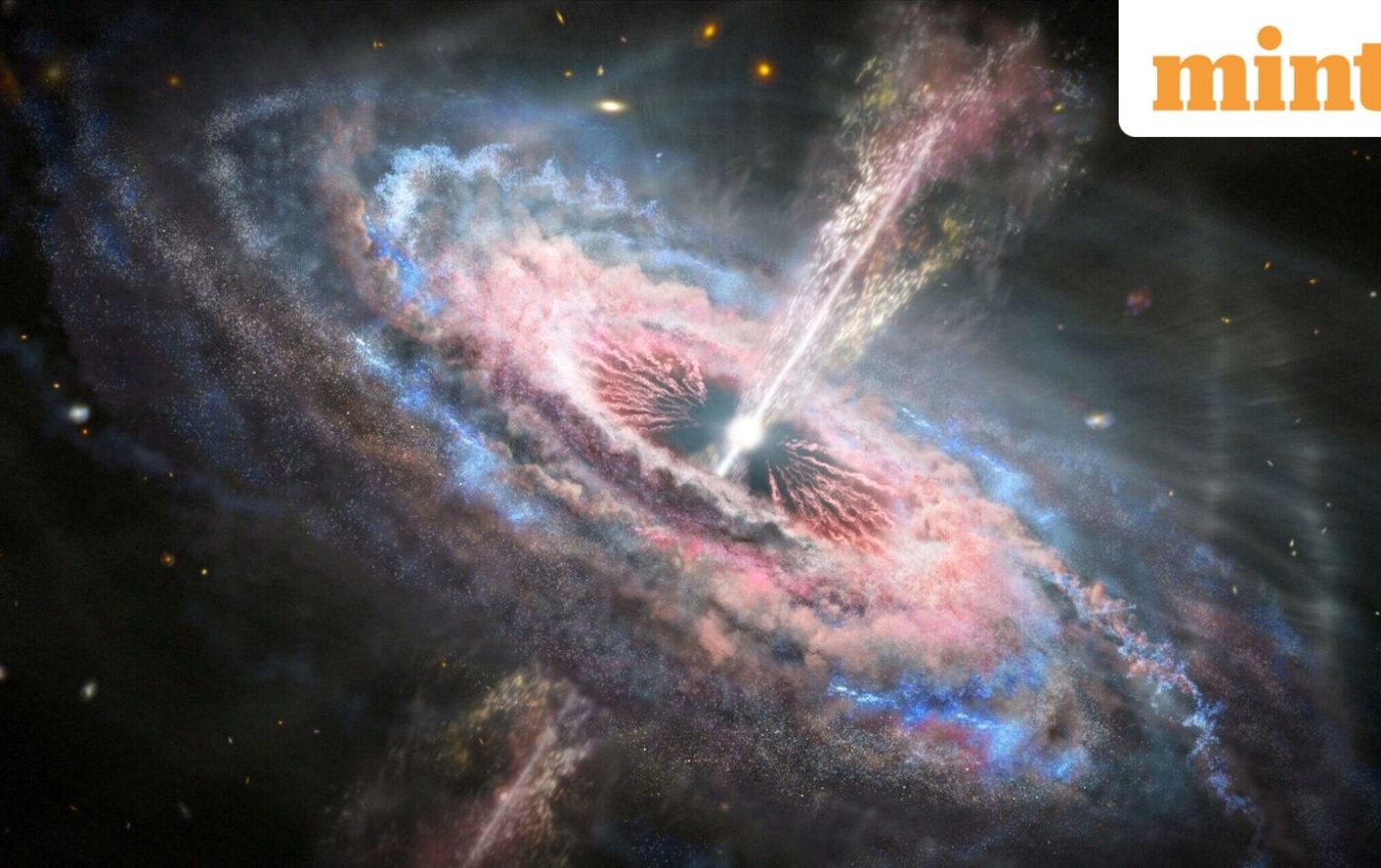
Can a black hole star solve the mystery of little red dots? Astronomers have made a groundbreaking discovery that could finally explain these enigmatic
Improved Article with SEO Optimization
Title: Can a Black Hole Star Solve Little Red Dot Mystery?
Article Content:
Theindiapostdaily.com – Can a black hole star solve the mystery of little red dots? Astronomers have made a groundbreaking discovery that could finally explain these enigmatic objects seen in the early universe. The newly identified celestial body, named MoM-BH-1, represents a unique class of objects that challenges our understanding of stellar evolution.
This remarkable object appears star-like in structure, measuring approximately the size of our solar system. Yet it generates an astonishing 100 billion times more energy than our Sun. This extraordinary power output aligns more closely with black hole characteristics than traditional stellar properties.
The Discovery Through JWST
A US-led team of astronomers utilized the James Webb Space Telescope to identify this fascinating object. Their research, published in the prestigious journal Nature, revealed that MoM-BH-1 existed approximately 660 million years after the Big Bang. This places it among the earliest objects ever observed in cosmic history.
Since JWST began operations in 2022, astronomers have detected numerous extremely bright objects scattered throughout the early universe. Scientists have nicknamed these mysterious entities “little red dots” due to their distinctive reddish appearance in telescope images.
Understanding the Red Appearance
The exact nature of these little red dots has remained one of the most debated topics in modern astronomy. “What exactly these objects are has been one of the most debated topics of the JWST era,” explained lead study author Rohan Naidu from Hawaii University, as quoted by AFP.
The research team initially focused on understanding how certain galaxies in the young universe achieved such remarkable brightness and mass so quickly after the Big Bang. During their analysis of JWST images, they encountered one of these puzzling little red dots.
Scientists traditionally assume that extremely red objects in space are enveloped by dust particles. This dust creates a filtering effect similar to wildfire smoke changing the sky’s color. “When we see something very red in the universe, we often assume that it is surrounded by dust, like soot or ash,” noted Robert Simcoe, a study co-author from the Massachusetts Institute of Technology.
The Breakthrough Explanation
However, the researchers discovered something unexpected when examining the object’s light across different wavelengths. Certain wavelengths revealed complete absence of light, contradicting the dust hypothesis.
Instead of dust, hydrogen gas appeared to be responsible for the reddish appearance. This finding raised critical questions about the energy source powering such an enormous object. “You can’t be powering this by nuclear fusion, which is the energy source that sits at the heart of all the stars,” Naidu explained.
Through sophisticated computer modeling, researchers explored various potential explanations. Their simulations strongly suggested that the object is powered by a central black hole surrounded by a dense gas cocoon. This unique configuration creates the illusion of a giant star while deriving energy from black hole processes.
FAQ Section
What is a black hole star? A black hole star is a celestial object that appears star-like but derives its energy from a central black hole rather than nuclear fusion. How was MoM-BH-1 discovered? The object was discovered using the James Webb Space Telescope by a US-led team of astronomers. Why are little red dots significant? These objects help astronomers understand galaxy formation and evolution in the early universe. What makes MoM-BH-1 different from other objects? It combines star-like appearance with black hole energy production, existing just 660 million years after the Big Bang.
—
This article provides insights into one of astronomy's most exciting recent discoveries, helping readers understand how a black hole star might solve the mystery of little red dots in the early universe.