Supreme Court scraps all FIRs for NEET protesters; CJP calls off September 5 march
The Supreme Court scraps all FIRs filed against students who joined the NEET agitation, ending months of criminal exposure in a single sweeping order. A
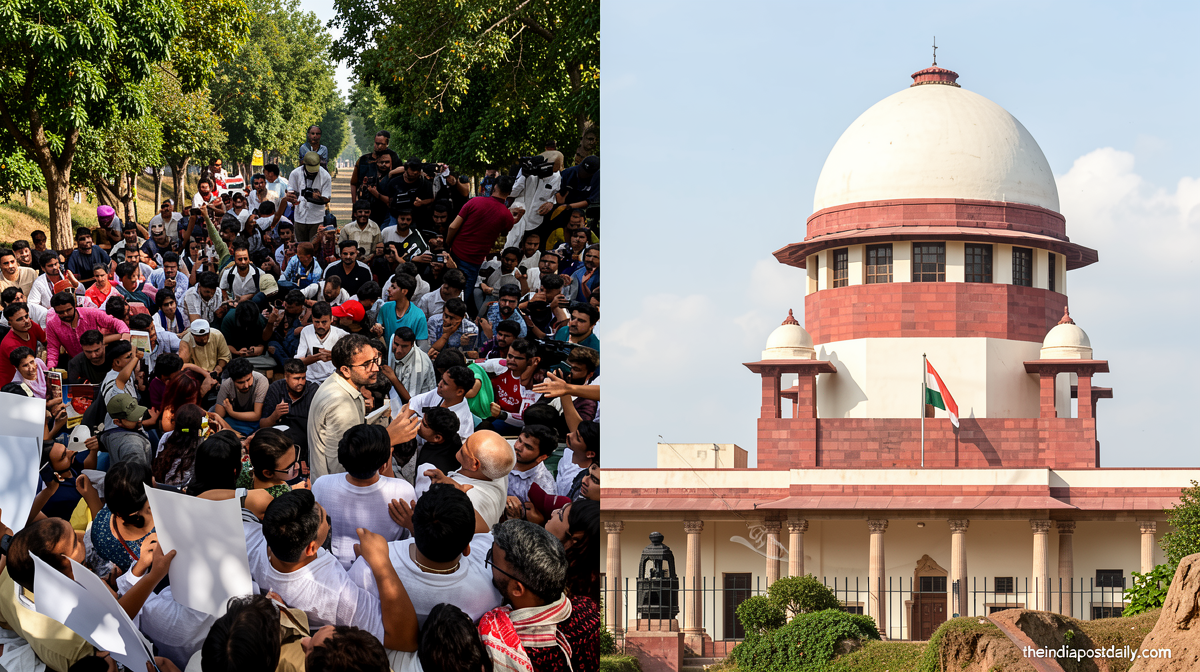
Supreme Court scraps all FIRs against NEET protesters
Theindiapostdaily.com – The Supreme Court scraps all FIRs filed against students who joined the NEET agitation, ending months of criminal exposure in a single sweeping order. A three-judge bench led by Chief Justice Surya Kant directed that every first information report registered in connection with the July 20–25 demonstrations be treated as closed, regardless of which state or union territory lodged it. The directive also bars police and prosecutors from registering any fresh complaint tied to those days of protest.
The ruling arrived on the same day the Cockroach Janata Party (CJP), the student collective behind a 36-day civil-disobedience campaign, told the bench it was pulling its planned September 5 march. The organisation framed the cancellation as a direct consequence of the court’s closure order, which it said resolved the principal grievance that had kept its leadership in continuous talks with New Delhi since late July.
Scope and Legal Basis of the Order
Justices Joymalya Bagchi and V Mohana sat alongside CJI Kant on the bench that issued the direction. The court anchored its authority in Article 142 of the Constitution, the clause that empowers the apex court to pass any order necessary to do complete justice. The closure was prompted by applications from the Union government and the state administrations of Delhi, Bihar, Maharashtra, West Bengal, and Assam — the five jurisdictions originally identified in the petition. Crucially, the bench extended the order beyond those five, instructing that no FIR in any other state or territory connected to the July 20–25 events may be pursued or investigated.
The practical effect is immediate: students who had been summoned for questioning, formally charged, or otherwise drawn into criminal proceedings over the agitation now face no pending liability arising from those incidents. The breadth of the closure forecloses any piecemeal prosecution in jurisdictions that had not yet been the subject of formal applications.
Courtroom Proceedings and Government Commitments
CJP co-convenor Saurav Das appeared before the bench to communicate the organisation’s decision to withdraw the September 5 march. Solicitor General Tushar Mehta, representing the Centre, urged the court to exercise its Article 142 powers to extinguish every FIR lodged against NEET protesters nationwide during the July 20–25 window. He affirmed that the government stood by the assurance it had extended to CJP leaders on July 25, when officials sought to persuade the group to conclude its prolonged agitation.
“The Centre is committed to honour the assurance given to the CJP leaders and provide compensation to the families of students who ended their lives after the cancellation of the NEET exam.” — Solicitor General Tushar Mehta
Mehta further told the court that compensation would be paid to families of students who died following the exam cancellation and the subsequent re-test, and he requested a three-month window to finalise the modalities of that package.
The Cancelled March and Its Context
The march, originally announced under the leadership of Abhijeet Dipke, was to have taken place in Delhi on September 5, Teachers’ Day. Its stated purpose was to press the government to fulfil promises made on July 25 — promises the CJP accused the Centre of failing to honour. The organisation had framed the event as a procession led by families of students who committed suicide in the aftermath of the NEET cancellation and re-test, alongside those who alleged police excesses during the July agitation.
With the criminal-case overhang removed, the CJP judged the march unnecessary and informed the bench of its withdrawal on September 1. The decision effectively concluded the most visible phase of a dispute that had drawn tens of thousands of students onto streets across India.
Background: From Paper-Leak Allegations to a Nationwide Movement
The agitation erupted after allegations of a question-paper leak in NEET, India’s single gateway to medical and dental undergraduate seats. The controversy triggered a cascade of student suicides, widespread public outrage, and ultimately a government decision to cancel the exam and conduct a re-test. What began as isolated campus walkouts escalated into a coordinated, multi-state movement sustained by the CJP for 36 days, with police responses during the July 20–25 demonstrations including the registration of numerous FIRs that now stand closed by court order.
Frequently Asked Questions
What exactly did the Supreme Court order regarding FIRs against NEET protesters? The court directed that every FIR registered in connection with the July 20–25 demonstrations be treated as closed for all intents and purposes, and that no new complaint may be filed in relation to those events. The order applies across all states and union territories, not only the five originally named.
Why did the CJP cancel its September 5 march? The organisation stated that the court’s closure order resolved the central grievance — the threat of criminal prosecution hanging over protesters — making the march unnecessary. The withdrawal was communicated to the bench on September 1.
What compensation has the government promised? Solicitor General Tushar Mehta told the court that the Centre would pay compensation to families of students who died after the NEET cancellation and re-test, and requested three months to work out the details of the package.
Which constitutional provision did the bench rely on? The court invoked Article 142, which grants the Supreme Court plenary power to pass any order necessary to do complete justice, to extinguish the criminal proceedings.