‘Should I give the money like an idiot?’: Kangana Ranaut tears into Mandi officials over ₹11 cr in unused funds
BJP Member of Parliament Kangana Ranaut erupted in anger during a district-level coordination meeting in Himachal Pradesh's Mandi constituency, accusing local
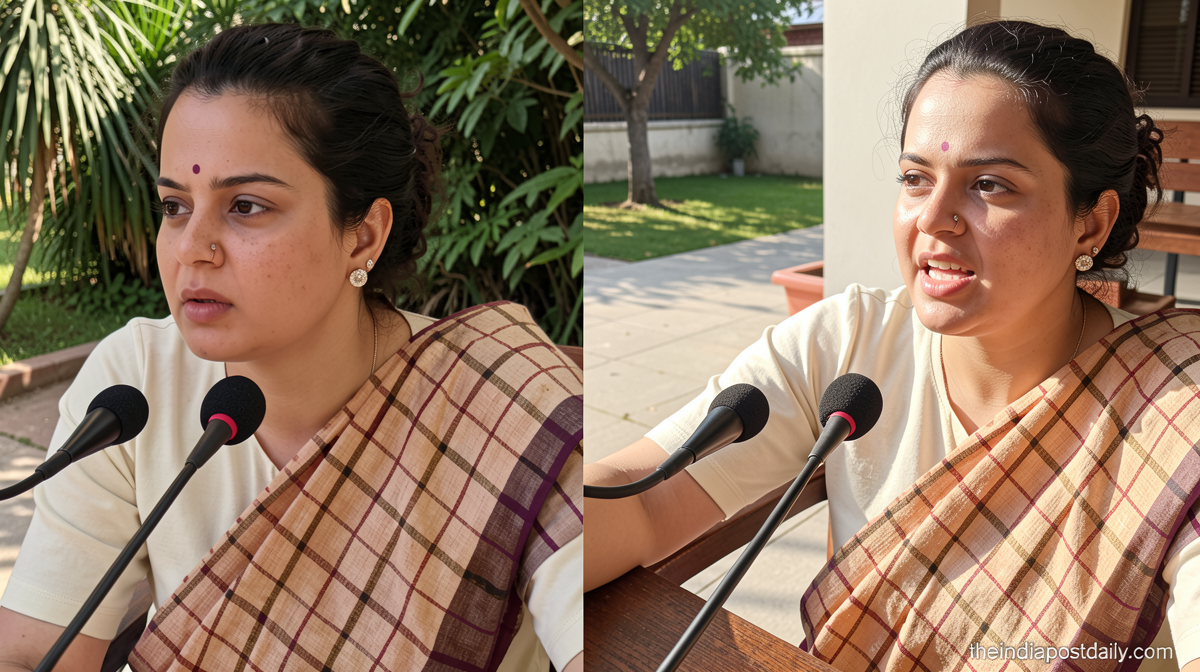
Kangana Ranaut Confronts Mandi District Officials Over ₹11 Crore in Stalled Development Funds
Theindiapostdaily.com – BJP Member of Parliament Kangana Ranaut erupted in anger during a district-level coordination meeting in Himachal Pradesh’s Mandi constituency, accusing local administrators of hoarding public money and letting development projects rot in bureaucratic limbo. The heated exchange, captured on video and quickly shared across social media, exposed a deepening rift between an elected representative demanding tangible delivery and the district machinery charged with executing sanctioned works.
The confrontation unfolded during a sitting of the District Development Coordination and Monitoring Committee, commonly known as DISHA, a body meant to bridge the gap between parliamentary allocations and ground-level implementation. Ranaut, who represents the Mandi parliamentary seat, pressed officials on why roughly half of an ₹11 crore development allocation remained unspent and why projects sanctioned under an earlier funding cycle were still sitting idle despite repeated review meetings.
“It’s Become a Bloody Joke”
The Mandi MP’s tone sharpened as the discussion dragged on. She accused the assembled bureaucrats of treating coordination meetings as mere theatre rather than instruments of accountability.
“What is this behaviour? Ye show-sha kyun kar rahe hain aap log meetings karne ka? Aap logon ko ye kaam kuch karna hi nahi hai. It’s become a bloody joke,” Ranaut said.
Her frustration extended beyond a single delayed project. She described a compounding backlog that made it nearly impossible to channel fresh allocations toward new infrastructure. Funds earmarked for the coming parliamentary year, she noted, were already being absorbed by unfinished older works rather than opening new avenues of development.
“Even now, the funds that have been given to me, including my next year’s MP fund allocation, which is still lying untouched, have to be allocated to those people. How am I supposed to do that? There is already a backlog. Am I supposed to keep handing out money like an idiot? Who is going to take care of this backlog?” she said.
Pressure on Implementing Agencies
Ranaut also alleged that certain beneficiaries or executing agencies had received disbursed amounts yet failed to commence or complete the associated work. She directed the district officials present to recover those sums and apply pressure on defaulting parties.
“You guys should put the pressure and take the public money back from them. Is it my scope of work? Sharm nahi aati kya tum logon ko?” she asked.
She further challenged the available manpower within the district administration, arguing that the remaining tasks could be cleared in a fraction of the time already consumed. In a pointed remark, she offered to personally demonstrate the pace at which work could proceed.
“Itne saare log ho, mujhe bolo na, mujhe tumhara ek office mile na ek din ke liye, main ek-ek din mein kaam karke dikhaungi,” she said.
What DISHA Is Supposed to Do
The DISHA framework was created to seat elected representatives alongside district authorities in a structured monitoring loop. Its stated purpose is to track the implementation of central government programmes at the district level, surface bottlenecks early, and ensure that sanctioned funds translate into physical progress within defined timelines. Government operating guidelines expect these committees to convene regularly, review programme status, and escalate obstacles that threaten timely execution.
In practice, however, Ranaut’s remarks suggest the mechanism has not delivered the accountability she expected. She claimed that officials required repeated written nudges from the Centre before completing even routine tasks, implying that the committee structure had degenerated into a formality rather than a functional oversight tool.
The MPLADS Context
The dispute sits squarely within the Member of Parliament Local Area Development Scheme, or MPLADS, under which each MP may recommend development works valued at up to ₹5 crore per year. District administrations and designated implementing agencies bear responsibility for executing approved projects and reporting progress. Official guidelines assign coordination and supervisory duties at the district tier and permit administrative action where serious delays, negligence, or non-compliance are identified.
When the scheme functions as intended, an MP’s role is largely recommendatory and oversight-oriented. Ranaut’s outburst, however, signals a representative who feels the district tier has abdicated its supervisory obligations, leaving her to chase funds through channels that were never designed for parliamentary micro-management.
Broader Implications
The episode underscores a recurring tension in Indian local governance: elected representatives, answerable to constituents and to public scrutiny, increasingly find themselves locked in adversarial postures with the very bureaucratic apparatus meant to execute their sanctioned programmes. Social media amplification of such encounters—memes, clips, and viral commentary—raises the political stakes for both sides. Ranaut herself acknowledged the reputational dimension, warning that she could take the administration’s work culture to a national audience if the impasse persisted.
“If I were to reveal all this, we would look how? How would it reflect on us as people? You guys should put the pressure on them and take the public money back from them. Is it my scope of work? Aren’t you people ashamed?” Ranaut said.
As of publication, the Mandi district officials named in the meeting had not issued a public response to Ranaut’s allegations. The unresolved question remains whether the DISHA structure can be recalibrated to restore functional oversight, or whether the gap between parliamentary expectation and district-level capacity will continue to widen into open confrontation.
Related Reading
Frequently Asked Questions
What is Should I give the money like?
Should I give the money like is the main topic of this guide. The article explains the context, practical details, and next steps readers should understand.
Why does Should I give the money like matter?
Should I give the money like matters because readers are looking for a useful answer, not just a short summary. Good content should match search intent and help them decide what to do next.