India, Belgium aim to double bilateral trade in five years
Two governments have formally committed to doubling the value of their bilateral commerce within five years, a pledge that signals a sharp acceleration in
New Five-Year Roadmap: India and Belgium Set Ambitious Target to Double Trade Volume
Theindiapostdaily.com – Two governments have formally committed to doubling the value of their bilateral commerce within five years, a pledge that signals a sharp acceleration in economic engagement between South Asia’s largest economy and one of the European Union’s founding member states. The announcement, made through a joint statement released on Thursday, frames the goal not merely as a trade statistic but as part of a broader strategy to deepen investment flows, expand technological collaboration, and build more resilient supply chains across multiple industrial sectors.
The target lands against a backdrop of already substantial commerce. India’s Ministry of External Affairs, in a bilateral relations brief updated in June, placed the two-way trade figure for fiscal year 2025-26 at $10.92 billion. Doubling that number would push annual exchanges past the $20 billion mark, placing the India-Belgium corridor among the more dynamic bilateral relationships India maintains within Europe.
Leaders Welcome Sector Diversification
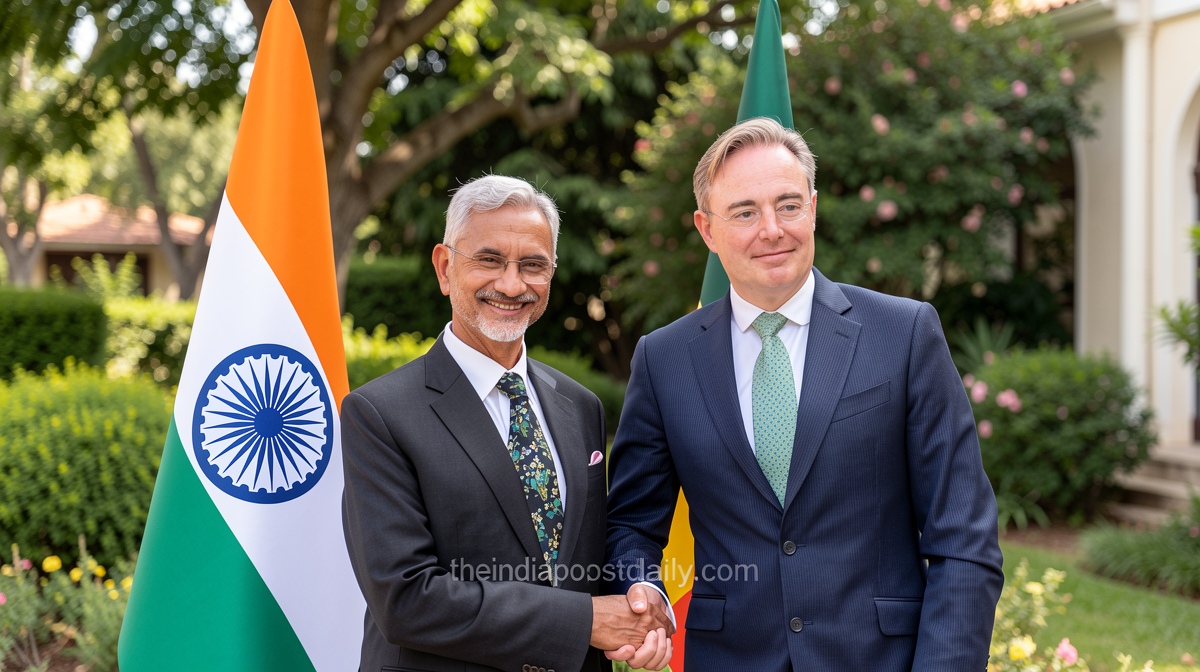
Prime Minister Narendra Modi and Belgian Prime Minister Bart De Wever jointly acknowledged what they described as the growing breadth of sectors now feeding into bilateral commerce. The list spans semiconductors, chemicals, pharmaceuticals, defence industrial collaboration, critical minerals refining and recycling, sustainable industries, and nuclear energy. This diversification marks a departure from the historically narrow profile of India-Belgium trade, which for decades has been anchored overwhelmingly in the diamond trade and, to a lesser extent, in pharmaceuticals, chemicals, and information technology services.
Belgium’s position at the administrative heart of European integration gives it a structural advantage as a gateway for Indian firms seeking EU market access. That role is expected to be amplified once the India-EU Free Trade Agreement moves from negotiation to implementation.
“Being at the centre of European integration, Belgium has been an important trade and investment partner for India within the EU for many years, particularly in diamonds, pharmaceuticals, chemicals, and the IT sector. Belgium is also likely to benefit from the India–EU FTA once it is implemented,” said Gulshan Sachdeva, professor, Centre for European Studies, Jawaharlal Nehru University (JNU).
“Now both countries are seeking to expand economic ties further into areas such as defence, renewable energy, and semiconductors—sectors in which Belgium has significant expertise. A dedicated investment platform, along with a bilateral agreement on mobility and migration, could further strengthen economic ties between the two countries,” he said.
India-EU Free Trade Agreement as a Force Multiplier
The two leaders specifically welcomed the successful conclusion of negotiations for the India-EU Free Trade Agreement, which was finalized during the India-EU Summit held on 27 January. They called for the agreement’s timely implementation, arguing that tariff reductions and regulatory alignment under the FTA would unlock substantially greater trade and investment collaboration by diversifying critical value chains and opening new market segments on both sides of the Atlantic-Indian Ocean corridor.
Beyond the FTA, the leaders urged the earliest possible conclusion of two companion instruments: the EU-India Investment Protection Agreement and the Agreement on Geographical Indications. Both are viewed as complementary legal frameworks that would reduce investor risk and protect origin-specific product names, respectively.
Technology, Economic Security, and Supply-Chain Resilience
Progress under the India-EU Trade and Technology Council was singled out for praise, including a ministerial-level meeting convened in Brussels in July 2026. The council’s mandate covers forging a more integrated, resilient, and sustainable economic and technological partnership. Within that architecture, India and Belgium reaffirmed their commitment to strengthening cooperation on trade policy, technology standards, economic security, and resilient supply chains.
Both sides also endorsed the Joint India-EU Comprehensive Strategic Agenda for 2030, a document designed to broaden and deepen the strategic partnership across political, economic, and security dimensions over the coming decade.
Investment Mechanisms and Sovereign-Fund Engagement
A concrete institutional step forward was the launch of the India-Belgium Investment Fast-Track Mechanism, described as a dedicated platform to facilitate and expand investment flows, support businesses navigating cross-border transactions, address recurring investment bottlenecks, and cultivate a more conducive environment for long-term economic cooperation.
Parallel to that mechanism, ongoing engagement between Belgium’s Federal Holding and Investment Company (SFPIM)—the country’s sovereign wealth fund—and India’s National Investment and Infrastructure Fund (NIIF) was noted with approval. The two governments expressed the hope of formalising the SFPIM-NIIF collaboration into what they termed an Indo-Belgian economic and investment corridor, a structured channel for co-investment in infrastructure, energy, and advanced manufacturing.
The Belgian Investment Company for Developing Countries (BIO Invest) was also acknowledged for its contribution to development-oriented investment in India, and both sides agreed to explore potential cooperation between BIO Invest and NIIF in areas of mutual interest.
Maritime, Port, and Logistics Cooperation
The strategic importance of maritime and port cooperation was underlined, with both governments welcoming opportunities to deepen collaboration in port development, logistics networks, connectivity infrastructure, dredging operations, and offshore wind energy infrastructure. Belgium’s long-standing expertise in port engineering and maritime logistics, combined with India’s expanding coastal infrastructure programme, positions this axis as a natural area for joint projects.
A Milestone in Business Engagement
On the bilateral economic front, the two leaders noted the successful Belgian Economic Mission to India conducted in March 2025. They recognised the mission as an important milestone in advancing bilateral economic engagement, fostering new partnerships between businesses and institutions, and expanding cooperation in priority sectors. The mission’s outcomes are expected to feed directly into the sector-specific initiatives outlined in the joint statement.
The combined effect of these commitments—trade doubling, investment fast-tracking, sovereign-fund collaboration, technology council engagement, and maritime cooperation—represents a comprehensive recalibration of India-Belgium relations from a historically narrow commercial relationship into a multi-dimensional strategic economic partnership, timed to coincide with the broader India-EU strategic realignment now underway.
Related Reading
Frequently Asked Questions
What is India Belgium aim to double bilateral?
India Belgium aim to double bilateral is the main topic of this guide. The article explains the context, practical details, and next steps readers should understand.
Why does India Belgium aim to double bilateral matter?
India Belgium aim to double bilateral matters because readers are looking for a useful answer, not just a short summary. Good content should match search intent and help them decide what to do next.