Five new judges appointed to Supreme Court: Here’s a look at each of their careers
Five New Supreme Court Judges: Career Highlights and Key Milestones Theindiapostdaily.com – On Tuesday, the Chief Justice of India, Surya Kant, administered the oath to five newly appointed judges, marking…
Five New Supreme Court Judges: Career Highlights and Key Milestones
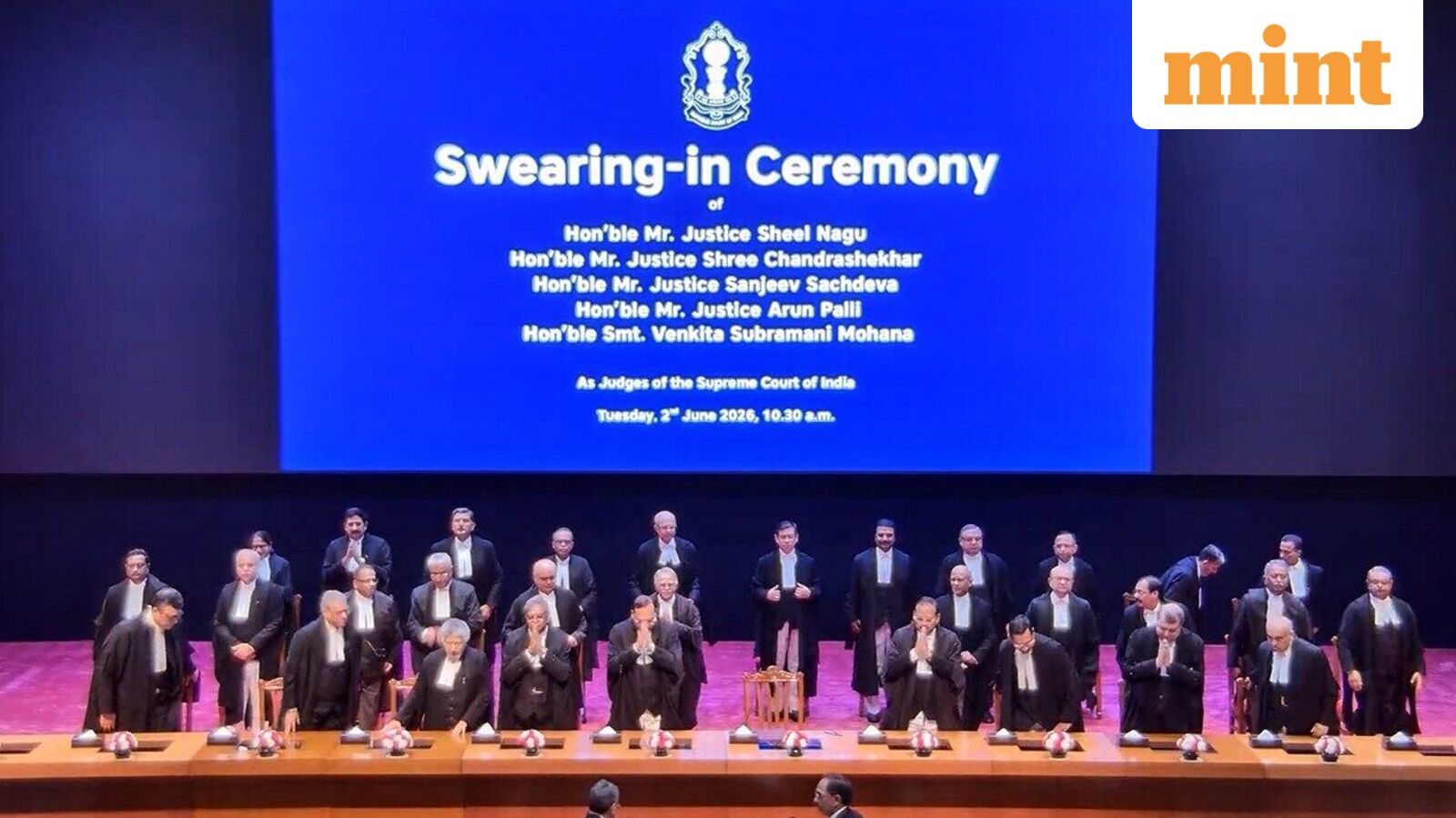
Theindiapostdaily.com – On Tuesday, the Chief Justice of India, Surya Kant, administered the oath to five newly appointed judges, marking a significant moment as the apex court’s bench now reaches 37 members. This expansion comes in the wake of two senior judges, Justice Pankaj Mithal and Justice J K Maheshwari, preparing to retire on 16 and 28 June, respectively. The appointments were swiftly approved, following the Supreme Court Collegium’s recommendation on 27 May, which took just four days to materialize.
Justice Sheel Nagu: A Journey from Advocate to High Court Leader
Justice Sheel Nagu, born on 1 January 1965, embarked on his legal career after enrolling as an advocate in 1987. His path to the bench began in 2011 when he was appointed an additional judge of the Madhya Pradesh High Court. By 2013, Nagu transitioned to a permanent position on the court. A notable milestone occurred in May 2024, when he served as acting chief justice of the Madhya Pradesh High Court before taking over as chief justice of the Punjab and Haryana High Court on 9 July 2024.
Nagu’s tenure also included a role in a high-profile inquiry. As part of a Supreme Court committee, he investigated allegations surrounding the discovery of burnt cash at the residence of then-Delhi High Court judge Yashwant Varma in March 2024. This experience underscored his involvement in critical legal matters, reflecting his commitment to judicial integrity.
Justice Shree Chandrashekhar: From Law Graduation to High Court Leadership
Justice Shree Chandrashekhar, born on 25 May 1965, completed his LLB at the University of Delhi’s Campus Law Centre in 1993. His judicial career began in 2013 as an additional judge at the Jharkhand High Court, where he became a permanent member by 2014. Chandrashekhar’s leadership extended to the role of acting chief justice from December 2023 to July 2024, a period that highlighted his administrative acumen.
Following this, he was transferred to the Rajasthan High Court, before being elevated to the Bombay High Court as its chief justice on 5 September 2024. His tenure as part of the Lok Sabha Speaker Om Birla’s three-member committee to examine Justice Varma’s case further demonstrated his expertise in judicial investigations.
Justice Sanjeev Sachdeva: A Senior Advocate’s Rise to the Bench
Justice Sanjeev Sachdeva, born on 26 December 1964, graduated with an LLB from Delhi University’s Campus Law Centre in 1988. His early career saw him become a practicing advocate in Delhi by August 1988, later gaining recognition as a senior advocate by July 2011. Sachdeva’s judicial journey commenced in 2013 when he was appointed an additional judge of the Delhi High Court, a position he solidified as a permanent judge by March 2015.
His career trajectory reflects a blend of legal scholarship and courtroom experience. Sachdeva’s contributions to the Delhi High Court’s operations and his later role in shaping the Bombay High Court’s direction highlight his versatility. As one of the new additions to the Supreme Court, his expertise is expected to bring fresh perspectives to the judiciary.
Justice Arun Palli: From Panjab University to High Court Chief Justice
Justice Arun Palli, born on 18 September 1964, earned his Bachelor of Laws from Panjab University in 1988. He ascended to the status of senior advocate in April 2007, a testament to his early professional achievements. Palli’s judicial career began in 2013 with his elevation to the Punjab and Haryana High Court, where he quickly gained prominence.
By April 2025, he had been appointed chief justice of the Jammu and Kashmir and Ladakh High Court. This appointment marks a pivotal chapter in his career, positioning him as a key figure in the region’s legal landscape. His swift rise to the top echelons of the judiciary underscores his dedication and competence in handling complex cases.
Justice V Mohana: A Woman Judge’s Path to the Supreme Court
Justice V Mohana, a seasoned lawyer, joined the Supreme Court as one of its two female judges. Prior to her elevation, she graduated from Coimbatore Law College in 1988 and practiced law for over three decades. Her designation as a senior lawyer by the Supreme Court in 2015 further cemented her reputation in the legal field.
Mohana’s presence on the Supreme Court adds diversity to the bench. She will join Justice B V Nagarathna, who has been a member of the court since August 2021. Notably, Nagarathna is set to become the next Chief Justice of India in September 2027, making Mohana a vital part of the court’s evolving leadership.
Context and Implications of the Appointments
The recent appointments reflect a strategic effort to balance experience and fresh perspectives within the Supreme Court. With five new judges joining, the court now boasts a diverse array of expertise, ranging from high court leadership to specialized legal practice. The swift process, completed within four days of the Collegium’s recommendation, highlights the efficiency of the appointments mechanism.
These appointments also coincide with the retirement of two senior justices, emphasizing the court’s continuous cycle of renewal. The incoming judges are expected to contribute significantly to the court’s work, particularly in addressing contemporary legal challenges. Their combined experience in high courts and advocacy positions them to handle cases with both depth and breadth.
Each of the five new judges brings a unique background to the Supreme Court. Sheel Nagu’s administrative experience, Chandrashekhar’s investigative role, Sachdeva’s courtroom prowess, Palli’s leadership in regional courts, and Mohana’s trailblazing presence as a woman jurist collectively enrich the judiciary’s composition. As the court prepares for the next phase of its journey, these appointments signal a commitment to maintaining its stature as the country’s highest judicial authority.
The swearing-in ceremony, held amid the impending retirements, underscores the importance of continuity in the legal system. While the outgoing justices will leave their mark, the incoming judges are poised to shape the court’s future. Their careers, marked by milestones in high courts and legal practice, exemplify the rigorous path to the apex bench. This expansion not only reinforces the judiciary’s strength but also its adaptability in meeting the demands of a rapidly evolving legal landscape.