‘US healthcare is a scam’: American woman says $1,000 medicine cost her just $25 from India
US Healthcare Is a Scam: American Woman Pays $25 for $1,000 Medicine from India US healthcare is a scam, according to Victoria, an American woman who shared
US Healthcare Is a Scam: American Woman Pays $25 for $1,000 Medicine from India
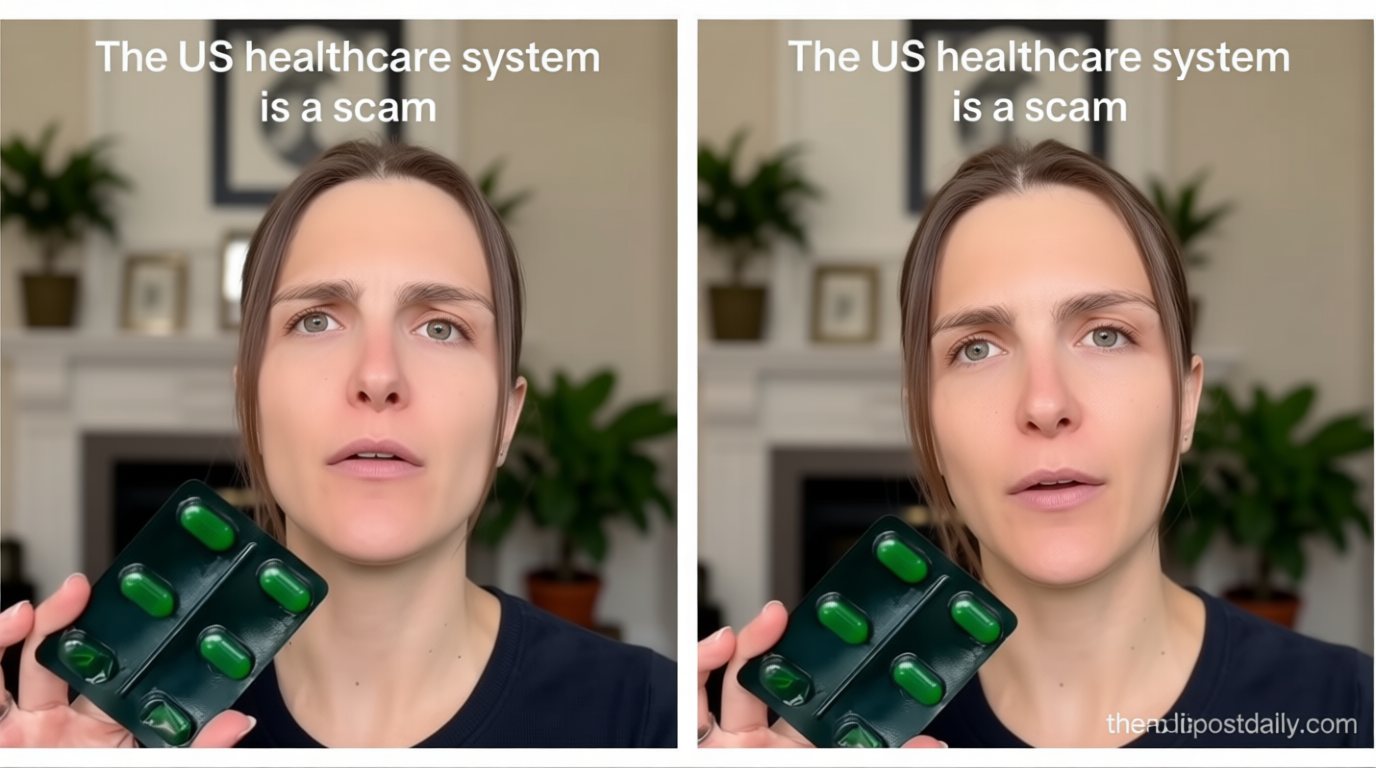
Theindiapostdaily.com – US healthcare is a scam, according to Victoria, an American woman who shared her shocking experience online. She revealed that a medication costing $1,000 in the United States was priced at just $25 when purchased directly from an Indian manufacturer. Her story has sparked a nationwide conversation about the affordability crisis in the U.S. healthcare system and the role of international pharmaceutical markets in offering more cost-effective solutions.
The High Cost of Prescription Drugs
Victoria’s frustration stems from the steep out-of-pocket expenses she faced in the U.S. When her insurance provider failed to cover the medication, she was left to pay the full price. “I was told this would cost $1,000 out-of-pocket in the U.S., but I ended up paying just $25 for six pills,” she explained in a widely shared Instagram video. This stark price disparity has become a symbol of the systemic issues plaguing American healthcare, where patients often bear the brunt of inflated drug costs.
“This medication was going to cost me $1,000 out-of-pocket in the U.S. and I bought it for $25. Yep, just for six little pills, $1,000 out-of-pocket because my insurance wouldn’t cover it,” Victoria remarked.
Her experience is not unique. Many Americans face similar challenges, with prescription drug prices rising faster than inflation. The U.S. remains one of the most expensive countries for medications, despite the availability of cheaper alternatives abroad. Victoria’s case highlights how patients are often forced to make tough choices between paying exorbitant prices and forgoing necessary treatment.
Alternative Routes and Cost Efficiency
Seeking a more affordable option, Victoria followed her doctor’s advice to have the prescription filled through a Canadian pharmacy. The doctor suggested this method as a way to access medicines directly from Indian manufacturers, bypassing the U.S. distribution system. “They told me to send the script to a Canadian Pharmacy, expecting maybe $100 or $200,” she recalled, but the actual cost was far lower.
“They were like $25. $10 for the medication itself, $15 for shipping. International shipping direct from the manufacturer in India to me,” she added.
Victoria’s success in saving hundreds of dollars underscores the potential of global sourcing in healthcare. By leveraging international markets, patients can access lifesaving treatments at a fraction of the U.S. price. This approach, however, requires patients to navigate complex logistics and sometimes rely on foreign pharmacies, raising questions about the accessibility of such solutions for all Americans.
Systemic Criticisms and Broader Implications
Victoria’s video quickly evolved into a broader critique of the American healthcare system. “Our healthcare system in the U.S. is a joke. We are being completely scammed,” she stated, questioning where the additional $1,000 cost was going. “What was I paying $1,000 for in the U.S.? Who is that money going to?” Her comments reflect growing public discontent over the inefficiencies and profit-driven motives of the U.S. pharmaceutical and insurance industries.
“Our healthcare system in the U.S. is a joke. We are being completely scammed,” Victoria said, sparking discussions about the fairness of drug pricing and the role of insurers in escalating costs.
Experts agree that the U.S. healthcare system’s structure contributes to high drug prices. Unlike other countries, the U.S. lacks centralized price controls for medications, allowing manufacturers to set prices based on market demand and profit margins. This has led to a situation where the same drug can cost significantly more in the U.S. than in other nations, even when the production cost is comparable.
Public Reaction and Global Comparisons
Victoria’s post has generated a wave of responses from social media users, many of whom share similar frustrations. “Fly to India, enjoy a week of holiday, go to the pharmacy, buy whatever you want, and come back to the U.S. It will cost you less than $1,000,” one commenter suggested, highlighting the idea of traveling abroad to access affordable medications. This sentiment has become a rallying point for advocates of international healthcare solutions.
“Cursing India but taking medicine from India,” another user wrote, pointing out the irony of criticizing yet relying on Indian pharmaceuticals.
Comparisons with countries like India and Canada have intensified as more Americans seek alternatives. India’s generic drug manufacturing industry has become a critical player in the global market, offering affordable versions of patented medications. Meanwhile, Canada’s healthcare system, which includes price negotiations with drug manufacturers, has emerged as a model for cost-effective prescriptions. These examples underscore the need for reforms in the U.S. to bridge the gap between patient costs and drug affordability.
Victoria’s story has also prompted calls for transparency in healthcare pricing. Patients and advocates are urging policymakers to address the disparities in drug costs and ensure that essential medications are accessible to all. With the rise of online platforms and social media, individuals like Victoria are amplifying their voices, pushing for change in a system that often leaves them struggling to afford basic care. The conversation is far from over, and her experience serves as a powerful reminder of the challenges faced by many in the U.S. healthcare landscape.