Mint Sustainability Summit: Net zero’s next phase demands deeper changes across supply chains
Achieving genuine net zero requires embedding environmental responsibility throughout supply networks, product development, and core business planning. This
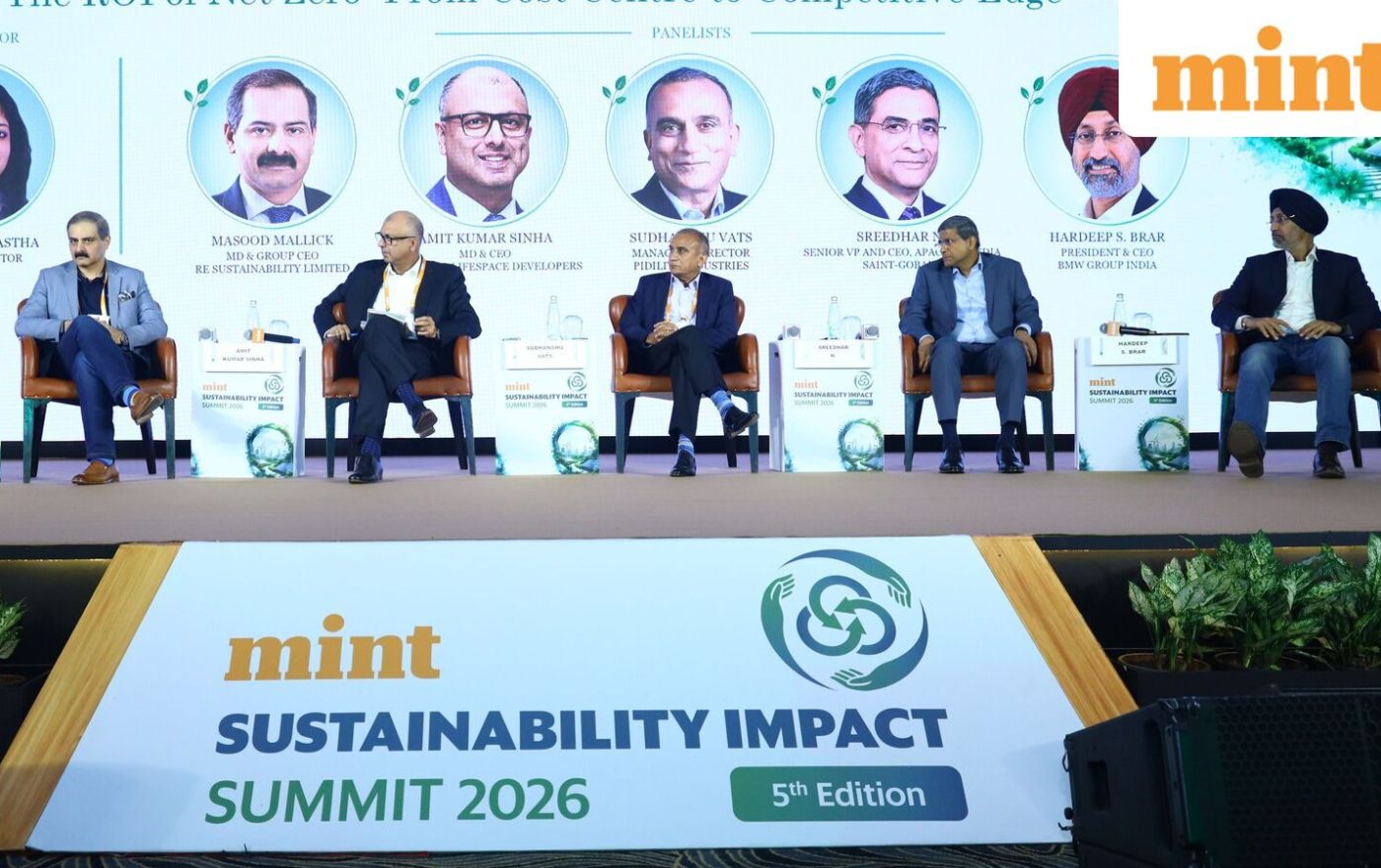
Mint Sustainability Summit: Net Zero’s Next Phase
Theindiapostdaily.com – Achieving genuine net zero requires embedding environmental responsibility throughout supply networks, product development, and core business planning. This was the central message from industry leaders gathered at the Mint Sustainability Summit 2026. The session, titled “The ROI of Net Zero: From Cost Centre to Competitive Edge,” explored how sustainability has transitioned from a regulatory obligation to a strategic advantage for businesses worldwide.
Panelists emphasized that future value will emerge through circular practices, collaborative relationships, consumer confidence, and enduring resilience rather than immediate operational improvements alone.
Building Circularity Into Business Models
Circularity involves creating products and materials designed for reuse, repair, recycling, or remanufacturing, ensuring resources remain active within the economy for extended periods.
We consume about 100 billion tonnes per annum as a global economy. About 93 billion tonnes out of that is extracted. 7% of that is circular, which means that it goes back into the economy. In 2028, this number was 9%, we were more circular globally in 2018 than we are today.
Masood Mallick, managing director and group chief executive officer at Re Sustainability Ltd, highlighted that environmental responsibility now represents business continuity rather than just an ecological concern.
Your ability to continue doing what you are doing- you cannot do that now if you do not control the supply chain. If your economic boundaries are broad enough in your supply chain and broad enough from a time standpoint, sustainability makes sense today. Not doing it does not make economic sense.
Measuring Real Value Creation
Amit Kumar Sinha, managing director and CEO of Mahindra Lifespace Developers, noted that while sustainability initiatives can reduce financing costs, the improvements remain relatively modest.
There are companies who are able to get this benefit… but it is in 10s of basis points and not 100 bps.
He explained that the more substantial opportunity lies in “overall lifetime economics with the customer” alongside the credibility gained through responsible corporate behavior.
However, the next evolution requires organizations to move past their current decarbonization commitments. As discussed at the Mint Sustainability Summit, companies must recognize that sustainability is no longer optional.
I have seen what sustainability means in Europe because it costs. In India, it is still not costing us. Because it costs (in Europe), the number of things people do there is far more mature than what we see in our country.
Sreedhar N., senior VP and CEO for APAC and India at Saint-Gobain, suggested that India could adopt European approaches such as building insulation. This technology could potentially cut electricity expenses by as much as 40% locally, compared to approximately 70% savings achieved in European markets.
Shaping the Future Playbook
Sudhanshu Vats, Managing Director at Pidilite Industries, identified three critical shifts needed to accelerate progress. The first involves transitioning from transactional relationships to genuine partnerships.
The shift that needs to happen at a faster pace is three-fold- one is beginning to look at partnership rather than looking at some of these things as transactional. If we start looking at it as a partnership, that changes the paradigm.
He further explained that organizations must consider total cost of ownership, recognizing that higher upfront investments can be offset over time.
Then you also start looking at total cost- total cost of ownership and running a place is a phenomenon that if you bring in then the initial cost which may be a little higher can be compensated.
For BMW Group India, sustainability has necessitated fundamental changes to both product offerings and operational approaches.
The customer does not want to compromise on performance.
Hardeep S. Brar, president and CEO, noted that electric vehicles must exceed traditional internal combustion engine models across critical performance metrics. He also highlighted evolving after-sales economics, explaining that reduced maintenance needs for electric vehicles are prompting companies to reconsider the necessity of extensive service networks.
Frequently Asked Questions
What was the main theme of the Mint Sustainability Summit 2026? The summit focused on how achieving net zero requires deeper changes across supply chains, circular economy practices, and moving sustainability from a cost center to a competitive edge for businesses.
How circular is the global economy today? According to Masood Mallick from Re Sustainability Ltd, only 7% of the 100 billion tonnes consumed globally is circular, meaning it returns to the economy. Interestingly, global circularity was higher in 2018 at 9%.
What are the key shifts needed for sustainability progress? Sudhanshu Vats from Pidilite Industries identified three critical shifts: moving from transactional to partnership models, considering total cost of ownership, and recognizing that higher upfront investments can be compensated over time.
How does India compare to Europe in sustainability adoption? Sreedhar N. from Saint-Gobain noted that sustainability in Europe costs more, leading to more mature practices. India could benefit from adopting European approaches like building insulation, which could cut electricity expenses by 40% locally.
What challenges do electric vehicles face in India? Hardeep S. Brar from BMW Group India explained that electric vehicles must exceed traditional internal combustion engine models in performance metrics. Additionally, reduced maintenance needs are prompting companies to reconsider extensive service networks.