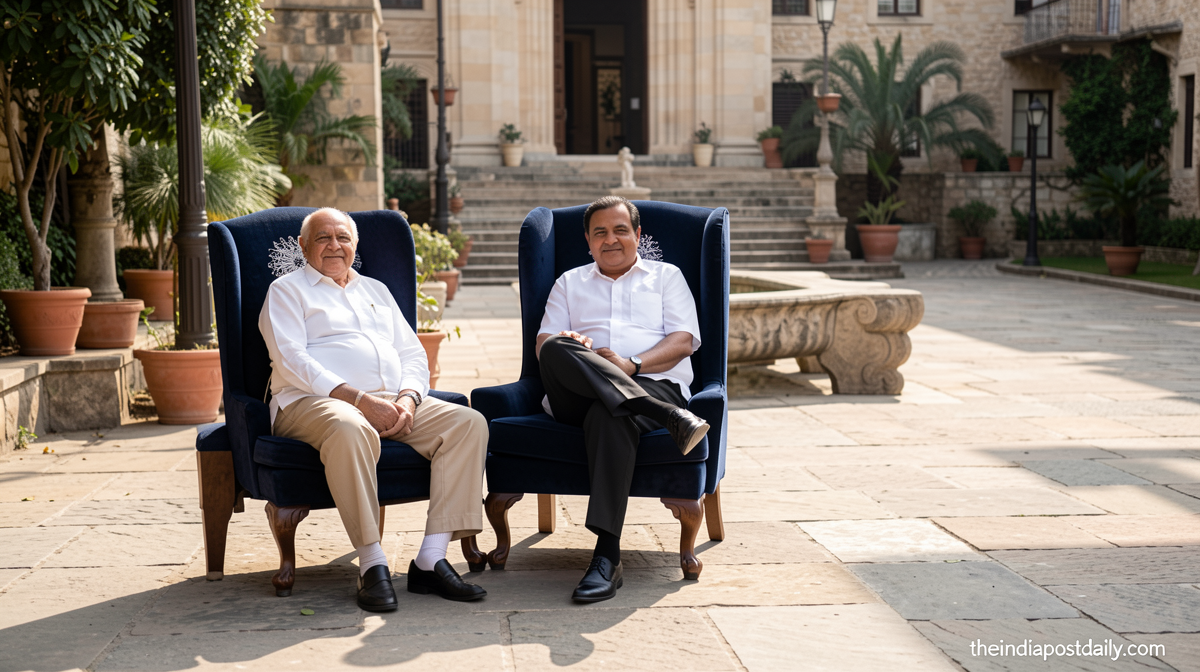
Bhupendra Patel meets Mukesh, Anant Ambani ahead of Vibrant Gujarat Global Summit; welcomes RIL’s contributions
The state of Gujarat is positioning itself at the intersection of India's industrial policy and its climate commitments, and the latest signal came from a
Gujarat’s Clean-Energy Ambition Takes Shape as Patel Courts Global Industry Ahead of 2027 Summit
Theindiapostdaily.com – The state of Gujarat is positioning itself at the intersection of India’s industrial policy and its climate commitments, and the latest signal came from a high-stakes meeting in Mumbai between Chief Minister Bhupendra Patel and the leadership of Reliance Industries. The encounter, held during the city’s roadshow events for the upcoming Vibrant Gujarat Global Summit, centered on scaling world-class manufacturing in solar power, green hydrogen, and advanced materials at the Jamnagar industrial corridor — a move that would place one of the country’s largest private conglomerates squarely at the heart of the nation’s clean-energy transition.
The timing is deliberate. With the 11th edition of the summit slated for the first half of January 2027 under the banner “Viksit Gujarat – Shaping Global Future,” the state government is using the roadshow circuit to lock in commitments from the country’s most powerful industrial houses before the global audience arrives. Patel’s engagement with Mukesh Ambani, chairman and managing director of Reliance, and his brother Anant Ambani was framed explicitly within that strategy.
A Meeting Anchored in Green Manufacturing
In a post on X following the encounter, Patel described the conversation as one that underscored Reliance’s “transformative contributions and ongoing mega investments across Gujarat,” spanning green energy ecosystems, petrochemicals, retail supply chains, and digital infrastructure. He stated that he welcomed the company’s stated intent to scale manufacturing in solar, green hydrogen, and advanced materials at Jamnagar, describing the move as strengthening the state’s role in driving India’s clean-energy transition.
“Delighted to meet Mr. Mukesh Ambani Ji, Chairman & Managing Director of Reliance Industries, and Mr. Anant Ambani during our Mumbai Roadshow engagements for #VGGS2027.”
The Jamnagar reference carries particular weight. Located in western Gujarat, the Jamnagar industrial zone already hosts Reliance’s massive petrochemical and refining operations. Layering solar-cell fabrication, green-hydrogen production, and advanced-materials plants onto that existing infrastructure would create one of the most vertically integrated clean-energy manufacturing clusters in Asia. For a state that has long marketed itself on hydrocarbons, the pivot toward renewables represents a structural reorientation of its industrial identity.
Broader Industry Outreach in Mumbai
The Ambani meeting was not an isolated event. Patel conducted a series of one-to-one sessions with senior executives from some of India’s largest conglomerates, inviting them to participate in the forthcoming state summit. Among those he named in a separate X post were Anand Mahindra, Ajay Piramal, Harsh Goenka, Dilip Shanghvi, Achin Gupta, Burjis Godrej, Nikhil Merchant, Amit Harlalka, Satish Pai, and Dipali Goenka — a roster spanning automobiles, pharmaceuticals, financial services, chemicals, and consumer goods.
The underlying message was consistent: Gujarat wants these firms not merely as attendees at a conference but as long-term operational partners. Patel urged industrialists and investors, both domestic and foreign, to adopt what he framed as a simple triad — come to the state, grow within it, and grow alongside it.
From Industrial Powerhouse to “Global Gateway”
Patel’s pitch to Consuls General, foreign-mission representatives, and industry figures present at the Mumbai roadshow drew on two decades of institutional memory. The Vibrant Gujarat Summit was launched in 2003, when Narendra Modi — now Prime Minister — was serving as the state’s chief minister. Over more than two decades, the annual event has become a fixture of global investment diplomacy, and Patel argued that the state has used that platform to cement its standing as India’s foremost industrial destination.
Yet the current iteration marks a qualitative shift. Where earlier summits emphasized conventional manufacturing, infrastructure, and export-oriented growth, the 2027 edition will foreground emerging sectors: semiconductors, fintech, artificial intelligence, green hydrogen, soft power, and what Patel termed “green growth.” The state’s stated objective is to expand beyond traditional industrial metrics and embed itself in the global supply chains of next-generation technologies.
What the Roadshow Signals
The Mumbai stop is the latest in a sequence of promotional engagements. Patel previously traveled to the United States and Canada to brief foreign investors on the summit, and also conducted a roadshow in Delhi. The cumulative effect is to build a pipeline of committed capital and technology partnerships before the January 2027 event opens its doors to a global audience.
For Gujarat, the stakes extend beyond a single state’s GDP figures. If Jamnagar becomes a genuine hub for solar-cell manufacturing and green-hydrogen electrolysis at scale, it would reduce India’s dependence on imported photovoltaic modules and hydrogen carriers — two areas where the country currently imports the bulk of its supply. The state’s pitch to foreign consular representatives was explicit: view Gujarat not merely as a destination for factory floors but as a dependable partner in long-term, multi-decade growth, with government support assured for those who bring fresh ideas and capital.
The question now is whether the commitments voiced in Mumbai’s boardrooms translate into ground-breaking at Jamnagar within the next eighteen months. The summit’s theme — shaping a global future from a developed Gujarat — leaves little room for ambiguity. The state has made its intentions public, and the industrial houses it has courted will be expected to follow through.
Related Reading
Frequently Asked Questions
What is Bhupendra Patel meets Mukesh Anant Ambani?
Bhupendra Patel meets Mukesh Anant Ambani is the main topic of this guide. The article explains the context, practical details, and next steps readers should understand.
Why does Bhupendra Patel meets Mukesh Anant Ambani matter?
Bhupendra Patel meets Mukesh Anant Ambani matters because readers are looking for a useful answer, not just a short summary. Good content should match search intent and help them decide what to do next.