Who will control the Arctic? Growing power struggle between Russia, China and the US | Explained
Who will control the Arctic? That question, once confined to academic footnotes, now dominates defence white papers, shipping-boardroom strategy sessions, and
Who Will Control the Arctic? Power Struggle Explained
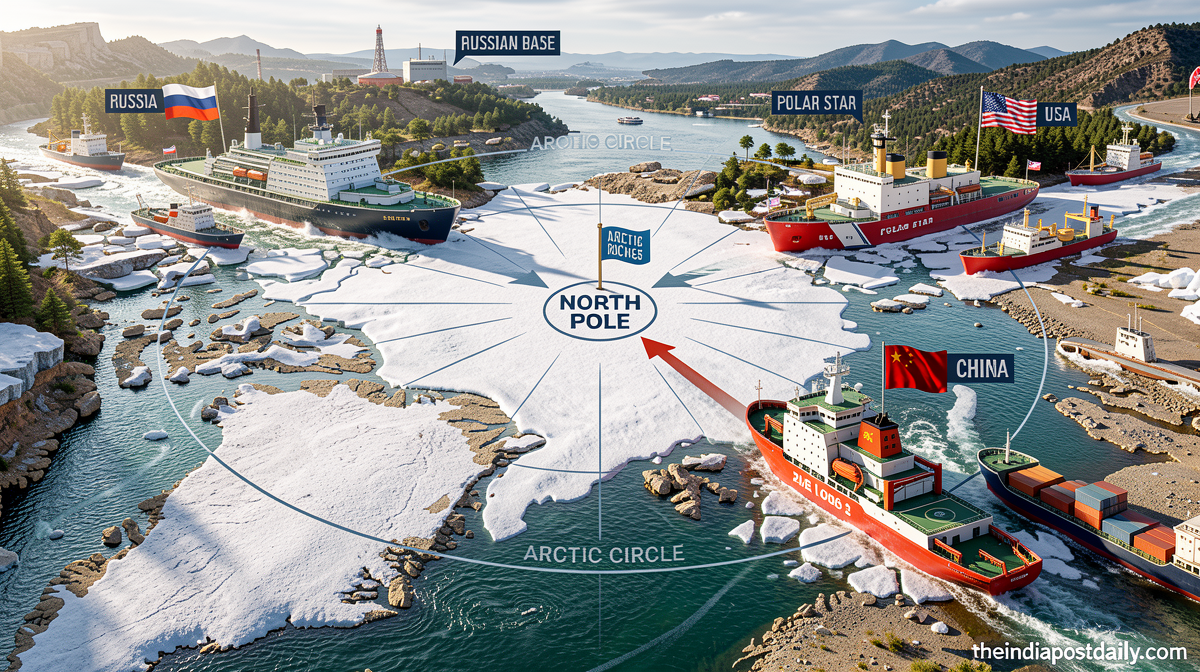
Theindiapostdaily.com – Who will control the Arctic? That question, once confined to academic footnotes, now dominates defence white papers, shipping-boardroom strategy sessions, and UN General Assembly debates. For most of the twentieth century the frozen north was a quiet backwater — vast ice fields, permafrost, and small indigenous communities that few capitals prioritised. That era has ended. Melting sea-ice, newly viable transpolar shipping corridors, and untapped mineral and hydrocarbon wealth beneath the seabed have turned the region into a sharpening contest among Moscow, Washington, and Beijing. What was once a zone of cautious multilateral cooperation has hardened into something closer to a strategic fault line.
Why the North Pole Suddenly Matters
Several converging forces have elevated the polar zone from peripheral curiosity to central concern. Geographically, the region sits astride the shortest sea lanes linking Asia, Europe, and North America. As summer ice retreats, routes such as the Northern Sea Route and the Northwest Passage are opening for longer seasonal windows, promising shorter transit times and lower fuel costs for commercial vessels. Geological surveys suggest substantial reserves of oil, natural gas, rare-earth minerals, and other extractable resources lie beneath the continental shelves. The elevated terrain and proximity to both hemispheres also make the area an ideal vantage point for missile-warning radars, satellite tracking, and undersea surveillance. Climate change acts as an accelerant: the north is warming at roughly four times the global mean rate, and sea-ice extent has contracted dramatically over recent decades, turning previously impassable waters into navigable channels within a single season.
Russia’s Dominant Position
No state commands a larger physical footprint in the region than Russia. Moscow controls approximately half of all landmass and half of the maritime exclusive economic zone lying north of the Arctic Circle. Demographically, roughly two-thirds of every person who calls the polar zone home lives within Russian borders. Economically, the picture is even more lopsided: while the region as a whole contributes only about 0.4 percent of global GDP, Russia alone accounts for roughly two-thirds of its economic output, according to figures cited by the Arctic Council.
Military infrastructure has been built up over decades. Research published by the Simons Foundation identifies thirty dedicated military sites across the wider north, complemented by hundreds of auxiliary defence installations, radar stations, and forward outposts. A substantial share of this posture revolves around Russia’s nuclear-powered submarine fleet. The Royal United Services Institute (RUSI) notes that Moscow has poured significant investment into modernising those submarines in recent years, while also expanding regional radar coverage, drone operations, and missile-capable platforms.
Analysts caution, however, that Russia’s absolute military capability in the north does not yet match the combined strength of NATO. What alarms Western capitals is less the raw number of assets than the pace and scale with which Moscow has expanded its footprint over the past decade — a trend that compresses reaction times and complicates allied planning.
NATO Closes the Gap and the Greenland Question
The post–Cold War period saw the frozen north function as one of the few remaining spaces where Russia and the West could work together. In 1996 the eight polar states — Russia, the United States, Canada, Denmark, Finland, Iceland, Norway, and Sweden — founded the Arctic Council to coordinate on environmental protection, biodiversity, and the rights of indigenous peoples. Russia also participated in two high-level sessions of the Arctic Chiefs of Defense Forum before its involvement ended following the 2014 annexation of Crimea.
The full-scale invasion of Ukraine in February 2022 effectively froze most bilateral and multilateral cooperation between Moscow and Western partners. The accession of Finland in 2023 and Sweden in 2024 to NATO then redrew the map: the alliance now borders Russia along the entire length of the Barents Sea and the Kola Peninsula. The region, once a cooperative commons, is broadly partitioned between a Russian sphere and a NATO sphere, creating a new strategic seam that both sides are learning to manage.
President Donald Trump’s repeated public assertions that the United States “needs” Greenland for national-security purposes have injected a fresh layer of controversy into an already tense environment. Greenland is an autonomous territory within the Kingdom of Denmark, a NATO member and long-standing American ally. Trump has argued that Copenhagen lacks sufficient military capacity to defend the island against potential Russian or Chinese encroachment, a claim that has drawn sharp diplomatic pushback from both Copenhagen and Washington’s own congressional allies.
China’s Rising Ambitions
Beijing, though not a coastal state, has staked out an increasingly assertive role. China designates itself a “near-Arctic state” and has invested heavily in icebreaker fleets, polar research stations, and satellite-imagery infrastructure. Its Belt and Road Initiative explicitly references polar logistics corridors, and Chinese firms have secured stakes in Norwegian and Finnish mining projects. For Moscow, Beijing offers a natural partner; for NATO members, it represents a third vector of influence that complicates an already binary confrontation.
The strategic question is no longer whether great powers will compete in the north — they already do. The question is whether that competition can be channeled into rules-based management, or whether it will slide toward the kind of open confrontation the region has not seen since the Cold War.
Frequently Asked Questions
Why is the Arctic becoming strategically important now?
Three factors converge: accelerating ice melt opens shorter shipping routes between Asia, Europe, and North America; geological surveys confirm large untapped oil, gas, and mineral reserves beneath the seabed; and the region’s elevated position makes it ideal for missile-warning and surveillance infrastructure. Together these shifts have drawn sustained military and economic investment from Russia, the United States, and China.
Which country has the largest Arctic footprint?
Russia controls roughly half of the landmass and half of the maritime exclusive economic zone north of the Arctic Circle. About two-thirds of the region’s resident population lives within Russian borders, and Moscow accounts for approximately two-thirds of the area’s economic output.
How has NATO’s expansion changed the Arctic balance?
Finland’s 2023 accession and Sweden’s 2024 accession to NATO extended the alliance’s land border with Russia along the entire Barents Sea and Kola Peninsula. Combined with the earlier loss of cooperative forums after 2014 and 2022, the north is now broadly divided into a Russian sphere and a NATO sphere, with fewer institutional channels for de-escalation.
What role does China play despite not bordering the Arctic?
Beijing self-identifies as a “near-Arctic state,” operates polar research stations, invests in icebreakers and satellite-imagery systems, and routes Belt and Road logistics planning through polar corridors. Chinese firms also hold stakes in Nordic mining and energy projects, giving Beijing economic leverage even without a coastline.