Delhi Metro employee breaks Guinness record, travels across all stations in 14 hours, 54 minutes
A Delhi Metro employee breaks Guinness World Records by completing a full circuit of every station on the Delhi–Noida–Gurugram rail grid in 14 hours, 54
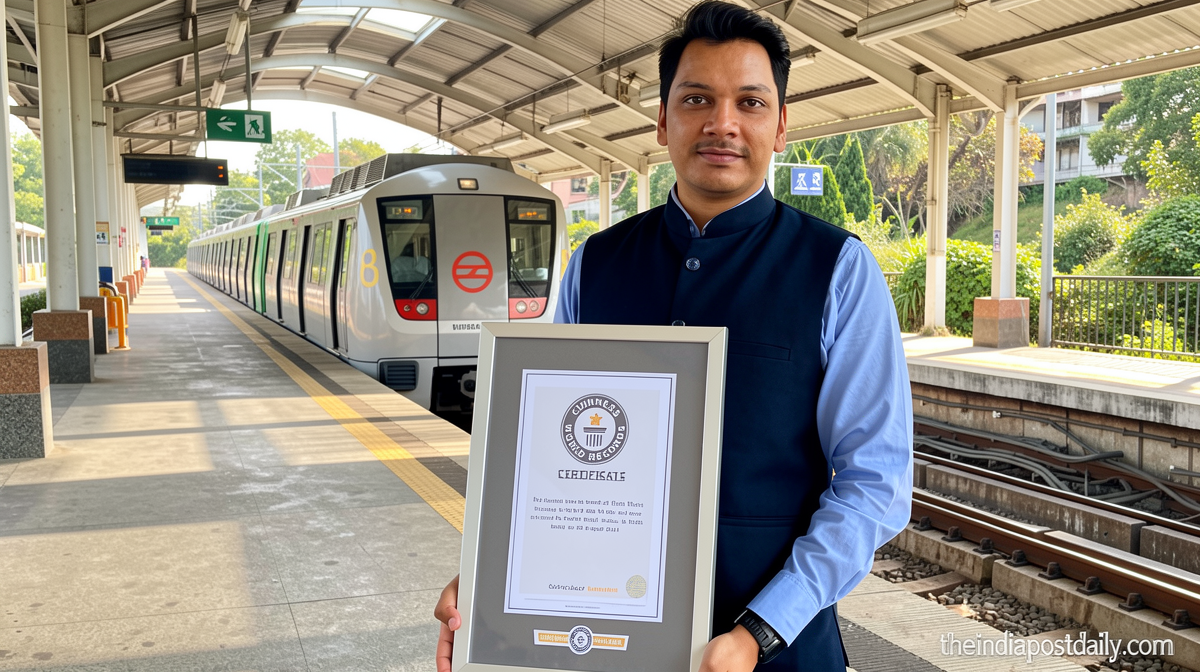
Delhi Metro employee breaks Guinness record
Theindiapostdaily.com – A Delhi Metro employee breaks Guinness World Records by completing a full circuit of every station on the Delhi–Noida–Gurugram rail grid in 14 hours, 54 minutes, and 36 seconds. Prafull Singh, an operations staffer at the Delhi Metro Rail Corporation, started his run at 6:00 AM on May 23 from Raja Nahar Singh station on the Violet Line and finished close to 9:00 PM at Millennium City Centre in Gurugram. Verified by Guinness World Records, the feat makes him the fastest person ever to ride through every stop on the city’s sprawling transit network without leaving the system.
The journey threaded through hundreds of stations spanning three metropolitan jurisdictions. Singh’s route was not a simple end-to-end ride; it required constant interline transfers, precise timing of headway intervals, and an intimate working knowledge of where and when the network would permit an uninterrupted circuit. His daily role monitoring train movements gave him a logistical edge no outside challenger could replicate.
How the Previous Mark Fell Short
The benchmark Singh surpassed stood at 15 hours, 21 minutes, and 4 seconds, set jointly by Sujoy Kumar Mitra and Shipra Gupta in June 2023. His new time trims nearly an hour off that figure. Singh himself had previously held the title in 2022, covering 254 stations in 16 hours, 2 minutes, and 17 seconds, but a navigational error during that run cost him roughly ninety minutes. For the second attempt he rebuilt his sequencing from scratch, aligning transfer points with natural service patterns rather than forcing long waits at interchange stations.
“I was sure of breaking the record with a significant margin this time. Last time I was delayed by one and a half hours because I had taken the wrong route. But this time I was sure,” Singh said.
What the Verification Protocol Actually Requires
Under the governing body’s rules, the train must come to a full physical halt at every station for the stop to register. The challenger need not step onto the platform, but must produce timestamped photographic evidence at each location confirming both the train’s presence and the station’s identity. Across several hundred stops, that translates into hundreds of individual captures taken in the narrow windows between departures, all while maintaining continuous travel.
The operational familiarity Singh brings to the task is considerable. Anticipating where the network will be most permissive for an uninterrupted circuit, understanding headway intervals, and reading operational windows are the same skills he exercises every shift. That professional context allowed him to sequence his route so that transfers aligned with natural service patterns, eliminating the dead-time that had plagued his earlier attempt.
A Showcase for Mass Transit
Singh framed the achievement not as a personal vanity project but as a demonstration of what the metro system can deliver at scale. The DMRC-operated network now spans over 350 kilometres of track and serves more than 500 stations across Delhi, Noida, and Gurugram, carrying roughly five million passengers on an average weekday. It ranks among the busiest metro systems in South Asia.
“This achievement is much more than a personal record for me. Being closely connected with DMRC, it was an opportunity for me to showcase the reach and efficiency of Delhi Metro and encourage greater use of public transport,” Singh said.
The record lands at a moment when Indian cities face sustained pressure to shift daily commuting from private vehicles to mass transit. Delhi’s air-quality crisis, chronic arterial congestion, and the government’s push for rail-based mobility all make a visible, high-profile endorsement of metro travel socially resonant. Singh’s fourteen-hour ride, broadcast widely across social media, effectively turned a single commuter’s endurance feat into a public-service message about the viability of rail as a primary transit mode.
FAQ
How long did the record-setting ride take? 14 hours, 54 minutes, and 36 seconds, from a 6:00 AM start at Raja Nahar Singh station to a finish near 9:00 PM at Millennium City Centre, Gurugram.
What made this attempt different from Singh’s 2022 run? In 2022 a navigational error added roughly ninety minutes. For the second attempt he restructured his entire route, aligning transfers with natural service patterns to eliminate dead-time at interchange stations.
What does the verification protocol require at each station? The train must come to a full physical halt, and the challenger must capture timestamped photographic evidence confirming the train’s presence and the station’s identity. Stepping off the platform is not required.
How large is the network Singh traversed? Over 350 kilometres of track and more than 500 stations across Delhi, Noida, and Gurugram, serving approximately five million weekday passengers.